EE-101 English Mar-Apr 2026 paper solved: letter to brother, pollution essay, annual day report
 Nookesh Karri ·· 24 min read

This post solves the AP SBTET C-23 EE-101 English question paper of March 2026, the common first-year paper written by DEEE and all other branches. You get every Part A grammar answer with a one-line rule, and complete model answers for all eight Part B questions, including the letter, essay, report, e-mail and comprehension. You can see the original question paper PDF here.
English question paper March 2026: pattern and syllabus units
The EE-101 English paper of March 2026 follows the usual C-23 pattern: 3 hours, 80 marks. Part A has 10 questions of 3 marks each (30 marks), and you answer all of them. Part B has 8 questions of 10 marks each; you answer any five (50 marks). The units below are from the C-23 DEEE curriculum.
| Q no | Topic | Syllabus unit (C-23) | Marks |
|---|---|---|---|
| 1 | Articles and prepositions | Unit 1 (1.2), Unit 2 (2.3) | 3 |
| 2 | Synonyms, antonyms, affixes | Unit 2 (2.2) | 3 |
| 3 | Primary helping verbs, modal verbs | Unit 3 (3.3, 3.4) | 3 |
| 4 | Verb forms (tenses) | Unit 5 (5.2), Unit 6 (6.2) | 3 |
| 5 | Active and passive voice | Unit 8 (8.1, 8.2) | 3 |
| 6 | Degrees of comparison | Unit 10 (10.3) | 3 |
| 7 | Polite request, negative, question tag | Unit 3 (3.3), Unit 7 (7.2) | 3 |
| 8 | Conjunctions, compound and complex sentences | Unit 10 (10.2) | 3 |
| 9 | Reported speech | Unit 9 (9.2) | 3 |
| 10 | Error correction | Unit 11 (11.3) | 3 |
| 11 | Paragraph: my college | Unit 4 (4.5), Unit 5 (5.3) | 10 |
| 12 | Dialogue on social media | Unit 3 (3.1, 3.5) | 10 |
| 13 | Letter to brother | Unit 7 (7.5) | 10 |
| 14 | Essay on environmental pollution | Unit 6 (6.1), Unit 8 (8.3), Unit 9 (9.3) | 10 |
| 15 | Report on annual day | Unit 11 (11.4) | 10 |
| 16 | Instructions: opening a savings account | Unit 7 (7.3) | 10 |
| 17 | E-mail, and Wh / Yes-No questions | Unit 6 (6.4), Unit 7 (7.2) | 10 |
| 18 | Reading comprehension (Marie Curie) | Reading skills (Unit 4, 4.3) | 10 |
In Part A, marks go only for the correct form, so write the full corrected sentence and underline the changed word. In Part B, choose Q18, Q16, Q17, Q13 and Q15. Comprehension and instructions are nearly mechanical, and the letter and report earn marks from a fixed format you can memorise. For more papers in this subject, see the English subject page.
Q1. Fill in the blanks with suitable articles and prepositions (3 marks)
(a) Articles. They have received a mail, having an important piece of information. The mail also has had an attachment with it.
- a before “mail”: a single thing mentioned for the first time.
- an before “important”: the next word starts with a vowel sound.
- The before the second “mail”: the same mail is mentioned again, so it is now definite.
The printed sentence drops “of” (“piece information”); the intended phrase is “an important piece of information”.
(b) Prepositions. Harsha received the “best teacher” award from the Rotary club on the occasion of Teachers’ Day.
- “received … from” names the giver; “on the occasion of” is a fixed phrase.
Key points to write: a / an / The; from / on / of.
Q2. Give synonyms, antonyms and affixes for the given words (3 marks)
| Part | Word | Answer |
|---|---|---|
| (a) Synonym | (i) Delicious | tasty |
| (a) Synonym | (ii) Rival | competitor (opponent) |
| (b) Antonym | (i) Public | private |
| (b) Antonym | (ii) Difficult | easy |
| (c) Affix | (i) Beauty | beautiful (suffix -ful); also beautify |
| (c) Affix | (ii) Honest | dishonest (prefix dis-); also honesty |
Rule for (c): a prefix goes before the root (dis + honest), a suffix goes after it (beauty + ful). When you add -ful to “beauty”, the y changes to i.
Key points to write: tasty, competitor; private, easy; beautiful, dishonest.
Q3. Fill in the blanks with primary helping verbs and modal verbs (3 marks)
(a) Primary helping verbs (be / have / do)
- My friends were in college by 8 a.m. yesterday. (plural subject, past time: “were”)
- Kalaam does not waste his time. (simple present negative with a singular subject takes “does not”)
- Suman has two dictionaries. (“has” shows possession with a singular subject)
(b) Modal verbs
- My parents used to live in a small house then. (past habit: “used to”)
- Lasya can handle this situation quite well. (ability: “can”)
- We must conserve our environment. (obligation: “must”; “should” is also accepted)
Note that the blank in (b)(i) is already followed by “to”, so the word to write is “used”, not “would”.
Key points to write: were, does, has; used, can, must.
Q4. Fill in the blanks with suitable verb forms (3 marks)
- I visit the library every day. (habit or routine: simple present)
- The thief had escaped from the spot before the police reached there. (the earlier of two past actions takes the past perfect)
- Sujan is doing his B. Tech. now. (“now” shows an action in progress: present continuous)
The paper prints “everyday” (an adjective); the adverb phrase is two words, “every day”. This does not change the answer.
Key points to write: visit, had escaped, is doing.
Q5. Change the voice of the following sentences (3 marks)
- (a) My mom gives me the pocket money every month.
→ I am given the pocket money by my mom every month. (or: The pocket money is given to me by my mom every month.) - (b) The results were declared by the board yesterday.
→ The board declared the results yesterday. - (c) Amar will decorate the house tomorrow.
→ The house will be decorated by Amar tomorrow.
Rule: the passive is “be” in the tense of the active verb + past participle; the doer moves into a “by” phrase. Sentence (a) has two objects (me, the pocket money), so either object can become the subject. Sentence (b) is already passive, so it changes to active.
Key points to write: is/am given, declared, will be decorated.
Q6. Change the degrees of comparison as directed (3 marks)
- (a) This dress is nicer than that dress. (“than” needs the comparative; nice + r)
- (b) Positive: No other student in the class is as hardworking as Saran.
- (c) Comparative: Shaheen is more curious than most other girls.
Rule: a superlative “the most X” becomes positive as “No other … is as X as …”. “Very few … are as X as A” becomes comparative as “A is more X than most other …”.
Exam tip: In (b), keep “the class” in the answer. “No other student is as hardworking as Saran” without it changes the meaning.
Key points to write: nicer; No other student … as hardworking as Saran; more curious than most other girls.
Q7. Write a polite request, a negative sentence and a question tag (3 marks)
- (a) Polite request: Mom, could you please help me complete my project work?
- (b) Negative: He did not submit the report last week.
- (c) Question tag: Karthik has neglected his studies, hasn’t he?
Rules: “Could you please …?” makes a request polite. A simple past verb (submitted) takes “did not” + the base form (submit) in the negative. A positive statement takes a negative tag with the same auxiliary, here “has”.
Key points to write: Could you please help me …?; did not submit; hasn’t he?
Q8. Use a conjunction and change into compound and complex sentences (3 marks)
- (a) They haven’t sent the bills online because the internet connection is very poor in the office. (“because” gives the reason; “as” or “since” are also correct)
- (b) Compound: I saw a snake in the classroom and ran into the ground.
- (c) Complex: Monica is so shy that she cannot speak to her colleagues.
Rules: a compound sentence joins two main clauses with a coordinating conjunction (and, but, so). “Too … to” becomes “so … that … cannot” in a complex sentence. In (b), “the ground” most likely means the playground; keep the words of the question.
Key points to write: because; saw … and ran; so shy that she cannot speak.
Q9. Change into reported speech and direct speech (3 marks)
- (a) Anil said, “I am writing my homework now.”
→ Anil said that he was writing his homework then. - (b) Akshay told me that I had not underlined the important points in that report.
→ Akshay said to me, “You have not underlined the important points in this report.” - (c) Manish said to Mohan, “Will you join me for the dinner tonight?”
→ Manish asked Mohan if he would join him for the dinner that night.
Rules: in reported speech the present continuous becomes the past continuous and “now” becomes “then”. For (b) reverse every change: “told me that” becomes “said to me” with inverted commas, “I” becomes “you”, “had not underlined” becomes “have not underlined”, and “that” becomes “this”. A yes/no question is reported with “if” and statement word order; “will” becomes “would” and “tonight” becomes “that night”.
Key points to write: was writing … then; “You have not underlined … this report.”; asked Mohan if he would join him … that night.
Q10. Correct the following sentences (3 marks)
- (a) Ravi sat beside Ram. (“beside” means next to; “besides” means in addition to)
- (b) Sarala has been working in this college since 2020, hasn’t she? (the auxiliary in the statement is “has”, so the tag uses “hasn’t”, not “isn’t”)
- (c) Sudha is one of my best friends. (“one of” is always followed by a plural noun)
Key points to write: beside; hasn’t she; friends.
Q11. Write a paragraph in 120 words describing your college (10 marks)
A paragraph is one block of writing about one idea. It opens with a topic sentence, adds supporting details in a logical order, and closes with a concluding sentence. The model below is about 120 words.
My College
I study Electrical and Electronics Engineering at the Government Polytechnic in our town, and I am proud of my college. It stands on a green campus with tall trees and a large playground. The main block has bright classrooms, a library full of technical books and a computer centre with internet. Our electrical laboratories have machines, meters and panels for practical work, so we learn by doing. The lecturers are friendly and explain every topic patiently. They also guide us for projects and placements. Every year the college celebrates sports day, annual day and national festivals with great enthusiasm. The NSS unit takes us to nearby villages for social service. My college has given me knowledge, discipline and good friends.
What earns marks: a clear topic sentence, details in order (campus, buildings, labs, teachers, activities), a closing sentence, correct grammar, and a word count close to 120. Write one single block; do not break it into many small paragraphs.
Q12. Construct a dialogue of 8 exchanges between two friends on the advantages and disadvantages of social media (10 marks)
A dialogue is a conversation written with the speaker’s name before each turn. “8 exchanges” means each friend speaks 8 times. Both sides of the topic (advantages and disadvantages) must come in.
Ravi: Hi Kiran, you look tired today. What happened?
Kiran: I stayed up late watching reels on social media. I didn’t notice the time.Ravi: That happens to many of us. But social media has its uses too, doesn’t it?
Kiran: Yes, of course. I chat with my school friends every day through it, even though they live in other towns.Ravi: I also follow some engineering channels. They explain circuits and machines very clearly.
Kiran: True. Our college posts notices and exam dates in a group, so we get the news quickly.Ravi: Some companies even post job openings online. It helps students find jobs.
Kiran: Right. But there are disadvantages too. People share fake news without checking it.Ravi: I agree. Some people also post private details and photos, and strangers misuse them.
Kiran: And it wastes a lot of time. I lost two hours last night and couldn’t finish my record.Ravi: Too much screen time also causes eye strain and poor sleep.
Kiran: Then what should we do? We can’t stop using it completely.Ravi: We can fix a time limit, say one hour a day, and use it mainly for learning.
Kiran: Good idea. I’ll also turn off notifications while I study.Ravi: And let’s check a fact before we forward any message.
Kiran: Agreed. Social media is a good servant but a bad master. Thanks, Ravi.
What earns marks: exactly 8 turns for each speaker, names before each turn, at least three advantages and three disadvantages, a natural opening and closing, and short, correct sentences in spoken style (contractions are fine in a dialogue).
Q13. Write a letter to your brother encouraging him to improve his communication skills in English (10 marks)
This is an informal (personal) letter. The format is: sender’s address and date at the top left, an informal salutation, the body in three short paragraphs, a closing such as “Your loving brother”, and your name. Do not write a “Subject” line or the receiver’s address inside an informal letter.
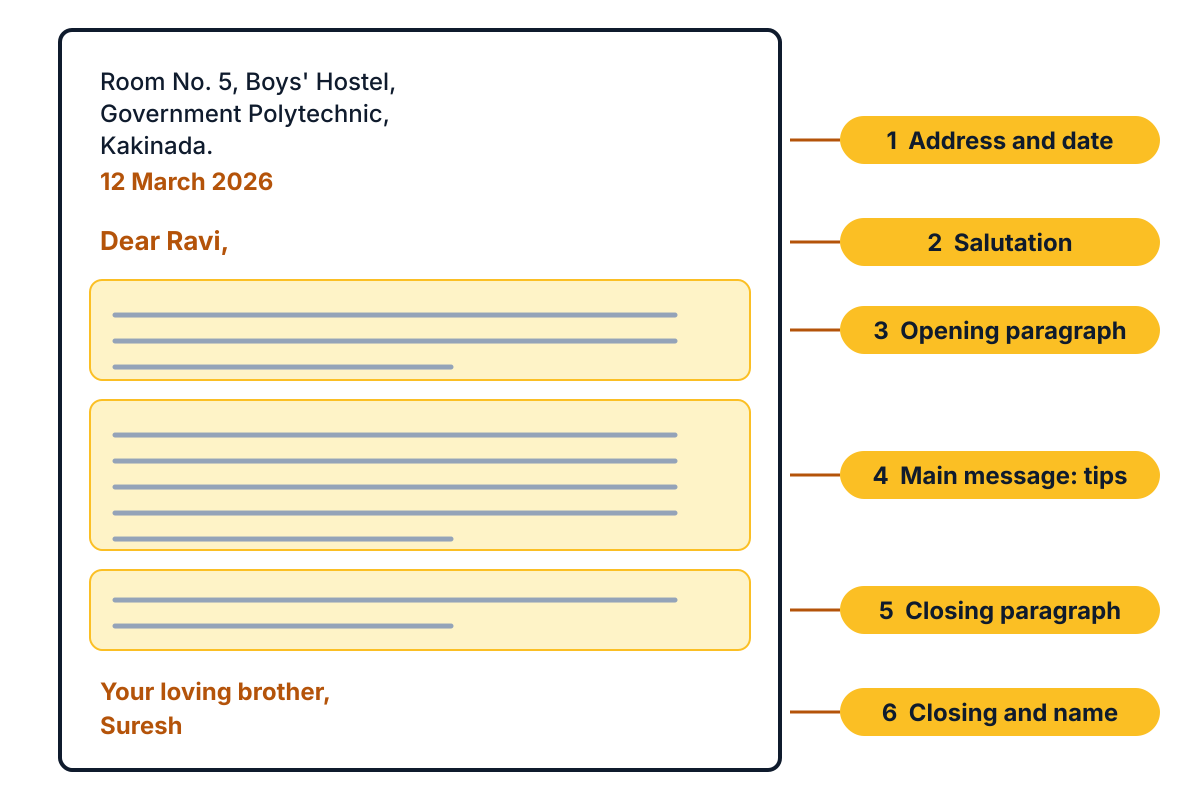
Figure: the parts of an informal letter, top to bottom. Each part carries marks.
Room No. 5, Boys’ Hostel,
Government Polytechnic,
Kakinada.
12 March 2026Dear Ravi,
I hope you are well and your studies are going on well. I am fine here. Mother told me on the phone that you are doing well in your exams. I am very happy about it.
I am writing to tell you about something important. Good marks alone are not enough today. Companies want people who can speak and write English clearly. In our campus interviews, many students with good marks could not answer simple questions in English. So, please start working on your communication skills now.
Read an English newspaper for at least twenty minutes every day and note down new words. Listen to English news and short talks, and repeat the sentences aloud. Speak in English with your friends for some time daily, even if you make mistakes. Write a short diary entry in English every night. Join the debate or elocution club in your school. Do not feel shy; everyone learns by making mistakes.
If you practise like this regularly, you will speak confidently within a few months. I will send you a good grammar book next week. Convey my regards to Father and Mother.
Your loving brother,
Suresh
What earns marks: the correct informal format (address, date, “Dear Ravi”, closing, name), a clear reason for writing, at least four practical tips, and a warm, encouraging tone. Never write your real hall-ticket details.
Q14. Write an essay on environmental pollution and suggest a few ways to control it (10 marks)
An essay has a title, an introduction, a body of two or three paragraphs and a conclusion. Here the body must cover the types and causes of pollution, its effects, and the ways to control it, because the question asks for both.
Environmental Pollution and Its Control
Introduction. Environmental pollution means the mixing of harmful substances into air, water and soil, which damages the health of people, animals and plants. It has become one of the biggest problems of our age. Growing cities, more vehicles and more factories have made it worse every year.
Types and causes. The main types of pollution are air, water, soil and noise pollution. Air is polluted by smoke from vehicles, factories, thermal power plants and the burning of waste and crop stubble. Water is polluted when sewage, factory waste and plastic are thrown into rivers, lakes and the sea. Soil is polluted by the overuse of chemical fertilisers and pesticides, and by plastic and electronic waste. Loudspeakers, horns and machines cause noise pollution.
Effects. Polluted air causes asthma, lung diseases and eye irritation. Dirty water spreads diseases such as cholera and typhoid, and it kills fish and other water life. Polluted soil gives poor crops, and harmful chemicals enter our food. Noise causes headaches, stress and loss of hearing. Pollution also adds to global warming and climate change, which bring floods, droughts and heat waves.
Ways to control pollution. Pollution can be controlled if the government, industry and every citizen act together.
- Use public transport, bicycles or electric vehicles, and keep vehicles well serviced.
- Factories must treat their smoke and waste water before releasing them.
- Generate more electricity from solar and wind energy, and save power at home.
- Plant trees and protect forests, because trees clean the air.
- Stop using single-use plastic; reduce, reuse and recycle waste.
- Use organic manure in place of excess chemical fertilisers.
- Do not burn garbage or crop residue, and keep the volume of loudspeakers low.
Conclusion. Pollution is created by human beings, so it can also be reduced by human beings. Laws alone cannot solve the problem; each of us must change our daily habits. As students of electrical engineering, we can also help by saving energy and promoting clean power. A clean environment is the best gift we can give to the next generation.
What earns marks: a title, a clear introduction, separate paragraphs for causes, effects and control, at least five practical control measures (the question asks for them), and a short conclusion. Use simple, correct sentences; you do not need statistics.
Q15. Write a report on the annual day celebrations organized in your polytechnic (10 marks)
A report gives a factual account of an event in the past tense. Its format is: a title, a by-line (who wrote it), the place and date, an opening paragraph that answers what, when, where and who, the main events in order, and a closing paragraph.
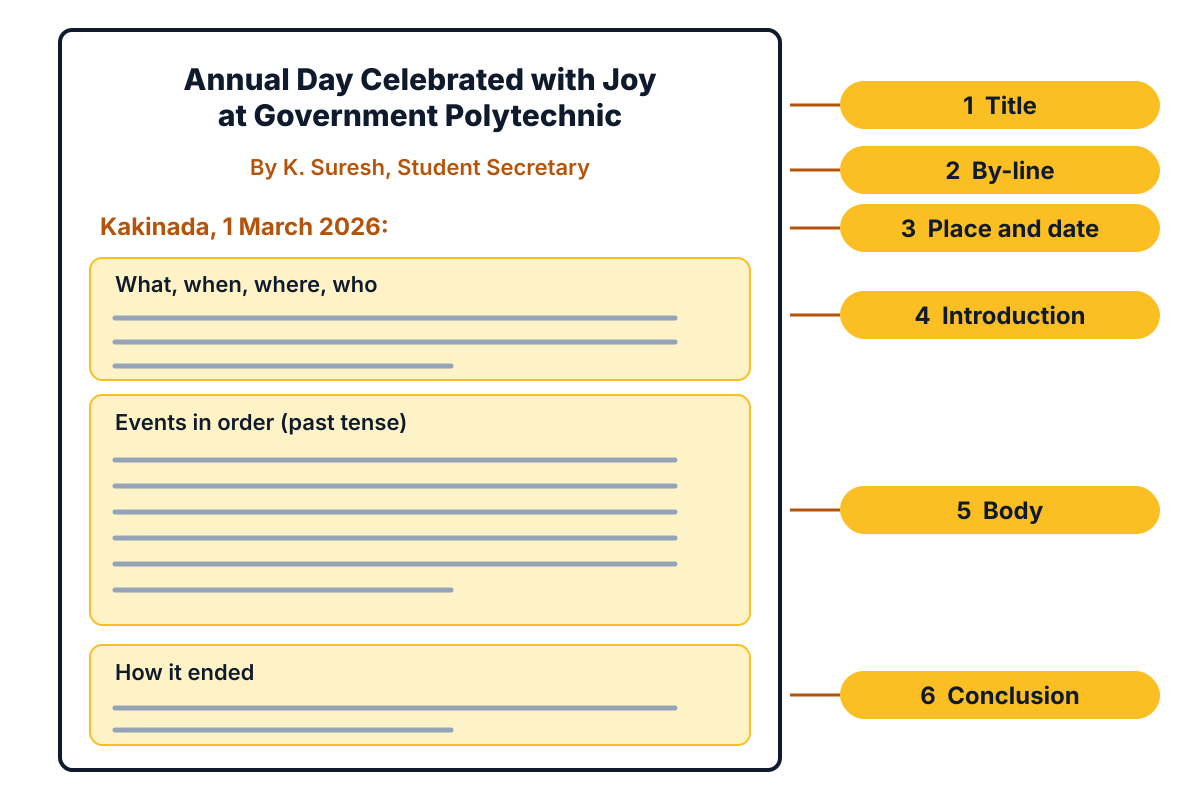
Figure: the report format. The opening paragraph must answer what, when, where and who.
Annual Day Celebrated with Joy at Government Polytechnic
By K. Suresh, Student Secretary, Cultural Committee
Kakinada, 1 March 2026: Government Polytechnic, Kakinada celebrated its annual day on 28 February 2026 in the college auditorium. Students, staff, parents and alumni attended the function, which began at 5 p.m.
The programme started with the lighting of the lamp and a prayer song. The Principal welcomed the gathering and read the annual report. He spoke about the good results of the final-year students, the campus placements and the prizes won in sports. A senior engineer from the local power distribution company was the chief guest. In his speech, he advised the students to learn practical skills and to work with honesty and discipline.
Next, the chief guest gave away prizes to the toppers of each branch, to the winners of sports events and to the student with the best attendance. The best outgoing student award went to a final-year student of the EEE branch.
The cultural programme was the highlight of the evening. Students presented classical and folk dances, songs, a skit on road safety and a mime on saving water. The audience applauded every item.
The function ended with a vote of thanks by the cultural secretary and the National Anthem. It was a memorable evening for everyone in the college.
What earns marks: a title, by-line, place and date, an opening that answers what, when, where and who, events in the correct order, the past tense throughout, and a closing sentence. Do not write it as a letter or a story with “I felt”.
Q16. Write a set of instructions on how to open a savings account in a bank (10 marks)
Instructions tell the reader what to do, step by step. Write a title, a list of things needed, numbered steps in the imperative (start each step with a verb: “Visit”, “Fill”, “Submit”), and a final note. For the documents, follow the list of officially valid documents that banks accept for KYC.
How to Open a Savings Account in a Bank
Things you need: any one officially valid document showing your name and address (passport, driving licence, proof of possession of Aadhaar number, voter’s identity card, NREGA job card or a letter issued by the National Population Register), your PAN card or Form 60, recent passport-size photographs, and some money for the first deposit.
- Choose a bank branch near your home or college.
- Visit the branch during working hours and go to the enquiry counter.
- Ask for a savings account opening form. Read the rules about the minimum balance.
- Fill in the form neatly in capital letters: your name, date of birth, address, phone number and e-mail.
- Write the name of a nominee in the nominee section.
- Paste your photograph in the space given and sign the form.
- Attach self-attested copies of your documents and take the originals for checking.
- Submit the form and the documents at the counter. The bank officer checks them and completes your KYC.
- Deposit the first amount with a pay-in slip.
- Collect your account number, passbook and debit card (or the date when they will be ready).
Note: Keep your passbook safe and never share your PIN, password or OTP with anyone, even if the caller says he is from the bank.
What earns marks: a title, the list of documents needed, steps in the correct order, every step in the imperative mood, short sentences, and a closing safety note.
Q17. Draft an e-mail about a campus placement drive, and frame Wh and Yes-No questions from the passage (10 marks)
The paper does not split the 10 marks; a fair split is about 6 marks for the e-mail and 4 marks for the questions.
(a) E-mail. An e-mail has a “To” address, a short “Subject” line, a greeting, a clear body, a closing and your name. Keep it short. Give the friend what, where, when, who can attend and what to bring.
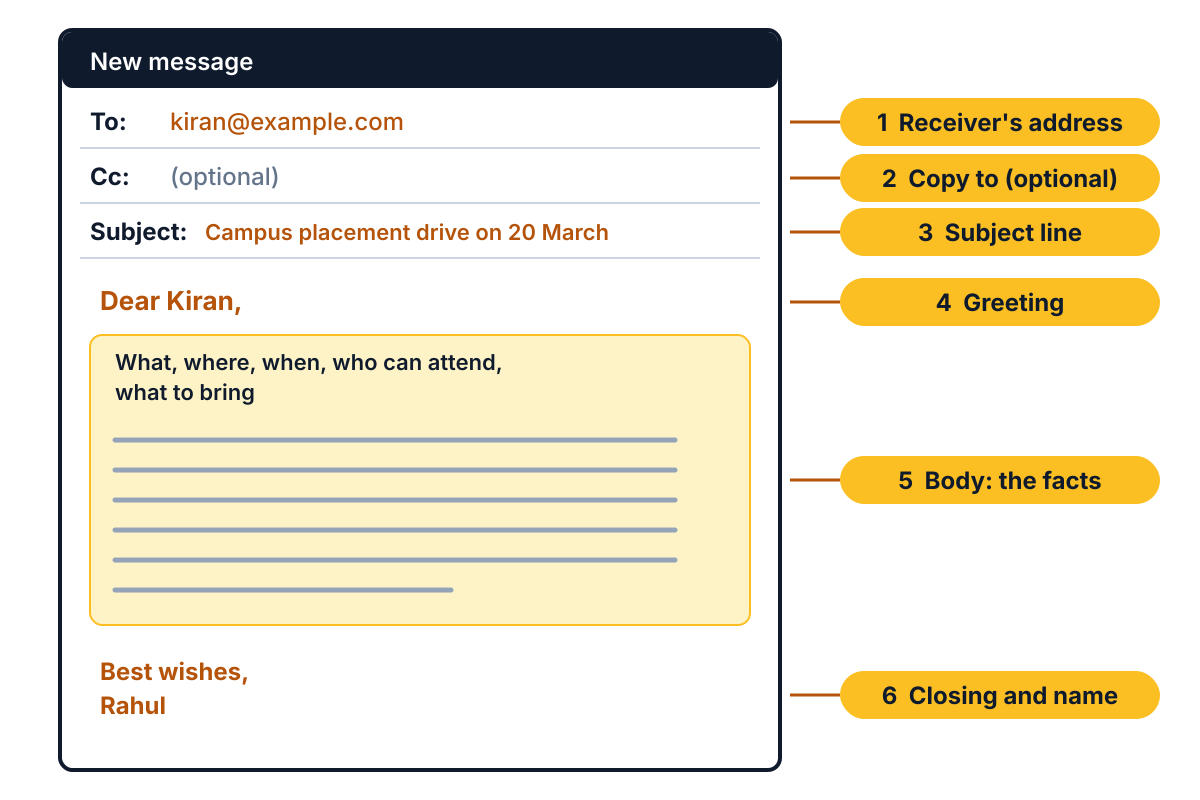
Figure: the e-mail format. The subject line should tell the reader the topic at a glance.
To: kiran@example.com
Subject: Campus placement drive at Government Polytechnic, Rajahmundry on 20 MarchDear Kiran,
I hope you are doing well. I have good news for you. A campus placement drive will take place at Government Polytechnic, Rajahmundry on 20 March 2026. It starts at 9.30 a.m.
Three companies are coming for electrical and electronics diploma students. Final-year students of EEE, ECE and Mechanical branches can attend. There will be a written test, a group discussion and an interview.
Please bring your resume, two passport-size photographs, your SSC certificate and copies of your semester mark lists. Wear formal dress and reach the venue by 9 a.m.
Let me know if you want to go together. We can prepare for the interview this weekend.
Best wishes,
Rahul
(b) Wh questions and Yes-No questions. A Wh question starts with what, why, how and so on, and asks for information. A Yes-No question starts with a helping verb (is, can, do) and is answered with “yes” or “no”.
Wh questions:
- What is an excellent source of knowledge? (Reading.)
- What do books open doors to? (New worlds, ideas and perspectives.)
- What does reading allow us to explore? (Different experiences and emotions.)
Yes-No questions:
- Is reading a powerful tool for personal growth? (Yes.)
- Can reading enrich our lives? (Yes.)
What earns marks: in (a), the To and Subject lines, a greeting, all key details and a closing; in (b), the right question word, the helping verb before the subject, and a question mark at the end of each question.
Q18. Read the passage on Marie Curie and answer the questions (10 marks)
Answer each question in a word, a phrase or one simple sentence, using the words of the passage. Each answer carries 1 mark.
| Q | Answer |
|---|---|
| (a) | Together with her husband, she discovered radium. |
| (b) | Radium is used for treating cancer. |
| (c) | As a child she showed a brilliant mind and a blithe (cheerful) personality. |
| (d) | The university in Warsaw was closed to women. |
| (e) | She studied at the Sorbonne, a French university. |
| (f) | She married Pierre Curie in 1895. |
| (g) | Pierre Curie was killed by a horse-drawn wagon in 1906. |
| (h) | She received the Nobel Prize in Chemistry in 1911, for isolating radium. |
| (i) | She suffered a fatal illness from her long exposure to radium. |
| (j) | consequence = result (also: effect, outcome). |
The passage prints “radiaoctive”; the correct spelling is “radioactive”. In (c), the passage uses “at an early age”, which the question calls “as a child”.
Exam tip: For (h), write both parts: the year (1911) and the reason (for isolating radium). The question asks “when” and “why”, so an answer with only the year is incomplete.
Key points to write: short answers in the passage’s own words, one line each.
FAQ
Which Part B questions are easiest to score in the EE-101 English March 2026 paper?
Q18 (comprehension) and Q16 (instructions) are the safest. Every Q18 answer is a phrase taken straight from the passage, and Q16 only needs clear numbered steps in the imperative. Q17 is also safe because its part (b) questions come from a short passage.
How many words should a 10-mark English answer be?
The paper says marks go for content, quality and clarity, not length. Q11 asks for 120 words, so stay close to that. For a letter, report or e-mail, about one page in the correct format is enough; an essay can run a little longer, with an introduction, a body and a conclusion.
What grammar topics came in Part A of the March 2026 EE-101 English paper?
Articles and prepositions, synonyms, antonyms and affixes, helping and modal verbs, tenses, active and passive voice, degrees of comparison, polite requests, negatives and question tags, conjunctions and sentence synthesis, reported speech, and error correction.
Is the format of the letter and report important in SBTET English?
Yes. Part of the 10 marks goes to the format: address, date, salutation and closing in a letter; title, by-line, place and date in a report; subject line and greeting in an e-mail. A good body in the wrong format loses marks.
Sources
- AP SBTET C-23 DEEE EE-101 question paper, Mar-Apr 2026
- C-23 Curriculum, Diploma in Electrical and Electronics Engineering, SBTET AP
- Prescribed textbook: INTERACT (A Text book of English for I Year Engineering Diploma Courses), SBTET AP
- Reference books (C-23 syllabus):
- Martin Hewings: Advanced Grammar in Use, Cambridge University Press
- Raymond Murphy: English Grammar in Use, Cambridge University Press
- Sidney Greenbaum: Oxford English Grammar, Oxford University Press
- Wren and Martin (rev. N.D.V. Prasad Rao): English Grammar and Composition, S. Chand
- Sarah Freeman: Strengthen Your Writing, Macmillan
- Question tags, LearnEnglish, British Council
- Reported speech 1: statements, LearnEnglish, British Council
- Reported speech 2: questions, LearnEnglish, British Council
- FAQs on Master Direction on KYC, Reserve Bank of India
Writes and reviews the SBTET EEE Papers solutions: AP SBTET diploma question papers answered step by step from the prescribed syllabus.