EE-101 English Mar-Apr 2025 paper solved: ATM instructions, ChatGPT essay, industrial visit report
 Nookesh Karri ·· 23 min read

This post solves the AP SBTET C-23 English question paper March 2025 (EE-101, common first-year paper, March/April 2025 board exam) question by question. Part A has 10 grammar and vocabulary questions of 3 marks each, and Part B has 8 writing and reading questions of 10 marks each, of which you answer 5. You can see the original question paper and check every answer here against it.
For grammar items you get the correct answer and a one-line rule. For the letter, report, essay, paragraph, dialogue and e-mail you get a complete model answer of exam length, plus a short note on what earns marks.
English question paper March 2025: pattern and syllabus units
The EE-101 English paper is 3 hours long and carries 80 marks: Part A is 10 × 3 = 30 marks (answer all) and Part B is 5 × 10 = 50 marks (answer any 5 of 8). Every question below maps to a unit of the C-23 DEEE curriculum and its prescribed textbook.
| Q no | Topic | Syllabus unit (C-23 English) | Marks |
|---|---|---|---|
| 1 | Articles, prepositions | Unit 1 (articles), Unit 2 (prepositions) | 3 |
| 2 | Synonyms, antonyms, one-word substitutes | Vocabulary (Units 2, 4, 6, 9, 11) | 3 |
| 3 | Primary helping verbs, modal verbs | Unit 3, Connect with Care | 3 |
| 4 | Tenses (verb forms) | Unit 5 (present), Unit 6 (past and future) | 3 |
| 5 | Active and passive voice | Unit 8, New Challenges - Newer Ideas | 3 |
| 6 | Degrees of comparison | Unit 1 (adjectives), Unit 10 (compare and contrast) | 3 |
| 7 | Negative sentences, polite request | Unit 7 (types of sentences), Unit 3 (requests) | 3 |
| 8 | Simple, compound, complex sentences | Unit 10, The Equal Halves | 3 |
| 9 | Direct and reported speech | Unit 9, The End Point First | 3 |
| 10 | Error correction (subject-verb agreement) | Unit 11 (errors), Unit 4 (agreement) | 3 |
| 11 | Paragraph writing | Units 4 and 5 | 10 |
| 12 | Giving instructions | Unit 7 (instructions) | 10 |
| 13 | Dialogue writing | Unit 3 (short dialogues) | 10 |
| 14 | Essay writing | Units 8 and 9 | 10 |
| 15 | Official letter | Unit 7 (letters) | 10 |
| 16 | Report writing | Unit 11 (reports) | 10 |
| 17 | (a) E-mail (b) Framing questions | Unit 6 (e-mails), Unit 7 (sentence types) | 10 |
| 18 | Reading comprehension | Reading skills (all units) | 10 |
My advice: in Part B choose Q18, Q17, Q15 and Q16 first, because they follow fixed formats and the comprehension answers are inside the passage. Take Q12 as the fifth; the instruction format is short and easy to score. In Part A, the safest marks are Q3, Q5 and Q10, where each blank has only one correct form. You can see other EE-101 sessions on the English subject page.
Q1. (a) Fill in the blanks with suitable articles; (b) fill in the blanks with appropriate prepositions (3 marks)
(a) I went to the doctor as I was feeling weak. The doctor advised me to eat an apple every day because it provides the most essential nutrients to the body.
- the doctor: the usual doctor we go to (“go to the doctor” is the common phrase; “a doctor” is also accepted).
- an apple: “an” before a vowel sound.
- the most essential: a superlative takes “the”.
(b) The chef prepared a cake made of chocolate and decorated it with white cream on top of it.
- made of (the material it is made of), decorated with (the thing used), on top of (a fixed phrase).
Key points to write: a/an for one non-specific thing, “an” before a vowel sound, “the” before a superlative.
Q2. Give synonyms, antonyms and one-word substitutes for the given words and phrases (3 marks)
| Part | Word or phrase | Answer |
|---|---|---|
| (a)(i) synonym | empathy | compassion / understanding |
| (a)(ii) synonym | whisper | murmur / mutter |
| (b)(i) antonym | captivate | repel / bore |
| (b)(ii) antonym | shrink | expand / grow |
| (c)(i) one word | a proficient public speaker | orator |
| (c)(ii) one word | an event that happens once in two years | biennial |
Exam tip: “biennial” means once in two years. “Biannual” means twice a year. Do not mix them up.
Key points to write: one clear word for each item; half a mark each.
Q3. (a) Fill in the blanks with primary helping verbs (be/have/do); (b) fill in the blanks with modal verbs as per the context (3 marks)
(a) Primary helping verbs
- Raju was ironing his college uniform when I went to his house yesterday. (past continuous: was + -ing)
- Shruti had finished the assignment even before I started it. (past perfect: the earlier of two past actions)
- Vaibhav did not attend Vamsi’s marriage last week. (past simple negative: did not + base verb)
(b) Modal verbs
- Ravindra Jadeja can field very well. (ability)
- Rajesh used to go to school by bus. (past habit)
- A student must qualify POLYCET for getting admission in Diploma programme. (compulsory obligation)
Rule: “used to” + base verb talks about past habits that don’t happen any more. “Can” shows ability, and “must” shows a strong rule or duty.
Key points to write: was, had, did; can, used to, must.
Q4. Fill in the blanks with suitable forms of the verbs given in brackets (3 marks)
- (a) I will have completed my diploma by 2026. (future perfect: an action finished before a future time)
- (b) Naresh has been working in this company for 15 years. He is a senior engineer now. (present perfect continuous: started in the past and still going on)
- (c) Virat practises batting in the nets regularly. (simple present for a habit; “practices” in American spelling)
Rule: “by + future time” goes with will have + past participle, as in the future perfect. “For + a period” with an action still going on goes with the present perfect continuous. “Regularly” signals a habit, so use the simple present with -s for “Virat”.
Answer: will have completed; has been working; practises.
Q5. Change the voice of the given sentences (3 marks)
- (a) The Pakistan army was defeated by the Indian army in the Kargil war.
- (b) The NSS volunteers decorated the college ground for the Republic Day celebrations.
- (c) Vaccines have been supplied to many countries by India during the Covid-19 pandemic.
Rule: the object becomes the subject, and the verb becomes be + past participle in the same tense. Past simple “defeated” becomes “was defeated”. Present perfect “has supplied” becomes “have been supplied” (plural subject “vaccines”). Sentence (b) is already passive, so it goes back to active voice in the past simple.
Key points to write: keep the tense the same; match “was/were, has/have” to the new subject.
Q6. Use the correct degree of the adjective and change the degree of comparison (3 marks)
- (a) Kashmir has the most beautiful scenery in India. (superlative: “the most” with long adjectives)
- (b) May is hotter than most other months of the year. (comparative)
- (c) No other economy in the world is as large as the USA. (positive)
Rule: “one of the + superlative” becomes “comparative + than most other”. “The + superlative” becomes “No other … as + positive + as”.
Exam tip: In (b) do not write “hotter than any other month”. The sentence says May is only one of the hottest months, so “most other months” keeps the meaning.
Q7. Rewrite as directed: negative sentences and a polite request (3 marks)
- (a) The students did not submit their records in time.
- (b) Could you please give me an application form to open a savings account?
- (c) Narendra Modi does not speak Telugu fluently.
Rule: in the past simple, add “did not” and use the base verb (submitted becomes did not submit). In the simple present with he/she, add “does not” and drop the -s (speaks becomes does not speak). A polite request starts with “Could you please …” or “Would you please …”.
The paper only says “change into a negative sentence”, so the plain negative above is the expected answer. If your teacher asks you to keep the same meaning, (a) becomes “The students did not fail to submit their records in time.”
Q8. Rewrite the sentences as directed: complex, compound and simple sentences (3 marks)
- (a) I cannot solve the problem because it is very difficult. (complex: main clause + “because” clause). Another correct form: “The problem is so difficult that I cannot solve it.”
- (b) Ramesh plays cricket and he also attends guitar classes on Sundays. (compound: two main clauses joined by “and”). Another correct form: “Ramesh not only plays cricket but also attends guitar classes on Sundays.”
- (c) Being very hard-working, Suraj is respected by everyone. (simple: one finite verb). Another correct form: “Suraj is respected by everyone for his hard work.”
Rule: a simple sentence has one main clause; a compound sentence joins main clauses with and, but, or, so; a complex sentence has a main clause and a dependent clause (because, that, when, who).
Q9. Rewrite as directed: direct and reported speech (3 marks)
- (a) Riyaz said that he was going to Ajmer.
- (b) Rakshitha asked me if I could buy her the book.
- (c) The teacher said to the students, “When will you submit the assignments?”
Rule: after a past reporting verb, move the tense one step back (am going becomes was going, can becomes could). Going from reported to direct speech, move it one step forward (would becomes will). Change the pronouns (I becomes he, you becomes I, me becomes her). Yes/no questions are reported with if or whether and normal word order.
The paper prints “enquired the students”; standard English is “enquired of the students” or “asked the students”. The direct speech answer is the same.
Q10. Rewrite the sentences after making necessary corrections (3 marks)
- (a) Every student has to choose one sport.
- (b) Mathematics is an interesting subject.
- (c) One of my brothers is going to Delhi on Monday.
Rule: “every” + singular noun takes a singular verb. Subjects like mathematics, physics and news end in -s but are singular. “One of” is followed by a plural noun and a singular verb.
Key points to write: has; is; brothers.
Q11. Write a paragraph in 125 words about the problems you experience while learning English and your solutions to overcome them (10 marks)
A good paragraph has one topic sentence, supporting sentences in a clear order (problem, then solution), and a concluding sentence. The model below has about 125 words.
Learning English: My Problems and Solutions
Learning English has not been easy for me. I studied in a Telugu medium school, so I have a small vocabulary. I often think in Telugu and translate, which makes my speech slow. I also make mistakes in tenses and articles. The biggest problem is fear: I hesitate to speak in class because I feel others will laugh at me. I have found some simple solutions. I read an English newspaper for fifteen minutes every day and note down five new words. I watch English news with subtitles. I practise speaking with two friends in English during lunch. I also write a short diary entry every night. My confidence has grown slowly. Regular practice, not fear, is the key to learning English.
What earns marks: a title, a clear topic sentence, two or three problems and a matching solution for each, a concluding sentence, and correct grammar. Staying close to 125 words matters more than writing long.
Q12. Write a set of instructions to your mother helping her to withdraw money from the ATM (10 marks)
Instructions are written as short numbered steps in the imperative (start with a verb: insert, enter, select). Add a short opening line and a few safety warnings at the end.
How to withdraw money from an ATM
Dear Amma, follow these steps carefully when you go to the ATM.
- Go to an ATM of our bank, or any ATM near our house, and check that the machine is working.
- Insert your debit card into the card slot in the direction shown by the arrow on the machine.
- Select the language you are comfortable with, such as Telugu or English.
- Enter your secret PIN on the keypad. Cover the keypad with your other hand while typing.
- Select “Withdrawal” or “Cash Withdrawal” on the screen.
- Select the account type “Savings”.
- Enter the amount you want and press “Confirm” or “Enter”.
- Wait for a few seconds and collect the cash from the cash slot. Count it.
- Select “Yes” if you want a receipt, and take the receipt.
- Take back your card before you leave the ATM.
Be careful:
- Never tell your PIN to anyone, not even to a bank employee.
- Do not take help from strangers inside the ATM room.
- If the card gets stuck or cash does not come out, call the bank’s helpline number written on the card.
Your loving son, ABC
What earns marks: steps in the correct order, every step starting with a verb, numbered layout, simple words for the reader (your mother), and the safety warnings.
Q13. Write a dialogue in at least eight turns between you and your friend about the causes and solutions for air pollution (10 marks)
Write the speakers’ names on the left, one turn per line, in natural spoken English. The question asks for at least eight turns; the model has ten.
Ravi: Hi Kiran, why are you wearing a mask today?
Kiran: Hi Ravi. The air near the bus stand is full of smoke and dust. My eyes were burning yesterday.
Ravi: Yes, air pollution is getting worse in our town. What do you think are the main causes?
Kiran: The biggest cause is smoke from vehicles. Old buses, autos and bikes give out a lot of black smoke.
Ravi: Factories also release harmful gases. And people burn garbage and plastic on the roadside.
Kiran: You are right. Dust from construction work and the burning of crop waste after harvest also add to it.
Ravi: So what can we do about it?
Kiran: We can use public transport, walk or cycle for short distances, and keep our vehicles serviced with a valid pollution certificate.
Ravi: The government should encourage electric vehicles and make factories fit filters on their chimneys. We should also plant more trees.
Kiran: Good idea. Let us start with our NSS unit. We can plant saplings on the campus and tell people not to burn garbage.
Ravi: Agreed. I will speak to our NSS lecturer tomorrow.
What earns marks: at least eight turns, both causes and solutions covered, natural greetings and replies, and correct punctuation (name, colon, words spoken).
Q14. Write an essay in 175 words about the advantages and disadvantages of ChatGPT for students (10 marks)
An essay has a title, an introduction, body paragraphs (here one for advantages and one for disadvantages) and a conclusion. The model has about 175 words.
ChatGPT for Students: A Boon or a Bane?
ChatGPT is an artificial intelligence chatbot. It answers questions, explains topics and writes text in simple language. Many students now use it every day.
ChatGPT has several advantages for students. It explains difficult concepts step by step, at any time of the day. It helps students to prepare notes, practise questions and improve their English. A student who is shy to ask the teacher can ask ChatGPT without fear. It also saves time when students search for ideas for projects.
However, ChatGPT has disadvantages too. Some students copy its answers for assignments without understanding them. This reduces their own thinking and writing skills. ChatGPT sometimes gives wrong or outdated information, and students may believe it blindly. Using it for long hours also keeps students away from books and friends.
To sum up, ChatGPT is a useful tool, but only if students use it wisely. They should use it to understand a topic, check every fact, and do their own work. Then it becomes a good guide.
What earns marks: a title, all four parts of the essay, balanced points on both sides, linking words (however, also, then) and a clear conclusion.
Q15. Write an official letter to your Principal requesting him to construct a new parking shed for the students to park their cycles and bikes (10 marks)
An official (formal) letter follows a fixed layout: sender’s address, date, receiver’s address, subject, salutation, body, complimentary close and signature.
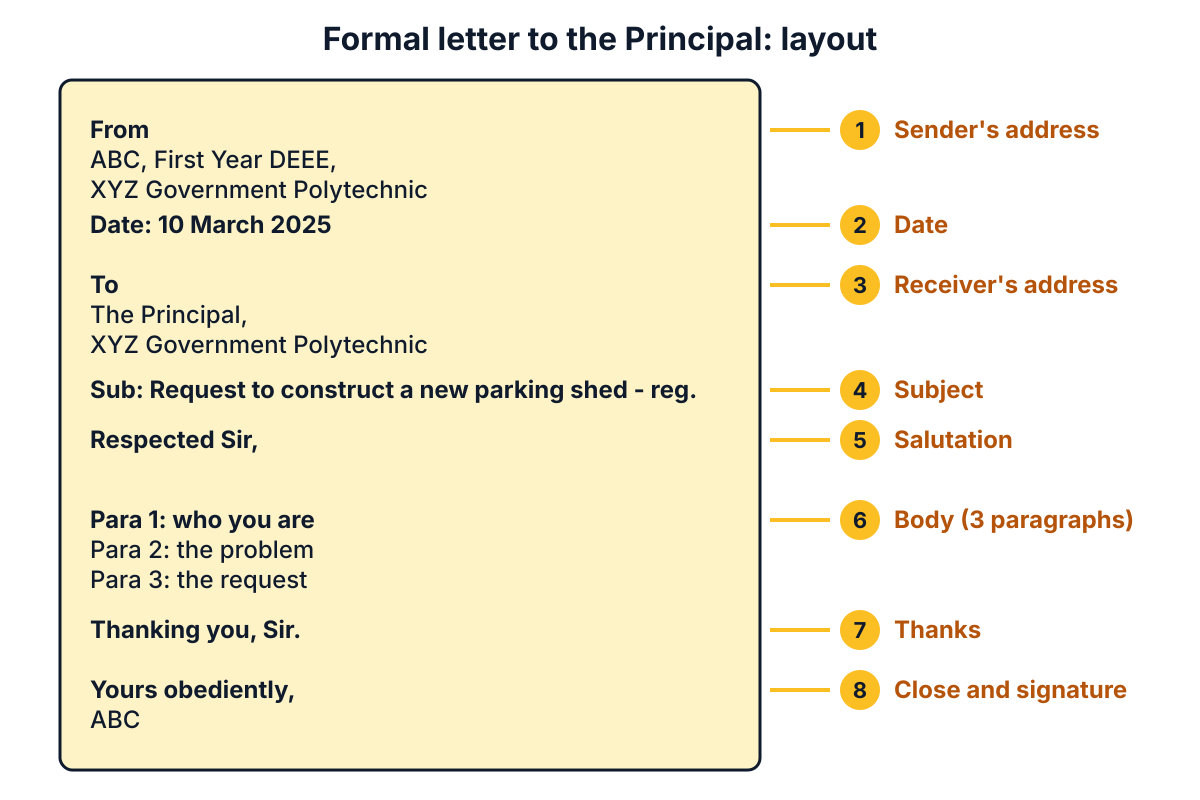
Figure: the eight parts of a formal letter, top to bottom, in the order you write them.
From ABC, First Year DEEE, XYZ Government Polytechnic, Anantapur.
Date: 10 March 2025
To The Principal, XYZ Government Polytechnic, Anantapur.
Sub: Request to construct a new parking shed for students’ cycles and bikes - reg.
Respected Sir,
I am a first-year student of the Electrical and Electronics Engineering branch. On behalf of all the students, I wish to bring a problem to your kind notice.
Many students come to college by cycle and motorbike. At present there is no proper parking shed for them. The vehicles are parked in the open, under the sun and the rain. Seats and tyres get damaged, and a few cycles were stolen last month. Vehicles parked in a disorderly way also block the path near the main gate.
I therefore request you to construct a new parking shed with a roof and a separate area for cycles and bikes. A watchman at the gate would also help. The students will park their vehicles in an orderly way and take good care of the shed.
Thanking you, Sir.
Yours obediently, ABC (On behalf of the students)
What earns marks: the correct format (every part in its place), a clear subject line, the problem explained in a polite tone, a specific request, and the formal close “Yours obediently”.
Q16. Write a report about the industrial visit of your class (60 members and two lecturers) to KIA Motors on 15th April 2024, to submit to your principal (10 marks)
A report is a factual account of an event in the past tense, written under clear headings: who, when, where, what was seen, and what was learnt. The paper says “comprising of”; correct English is “comprising” or “consisting of”.
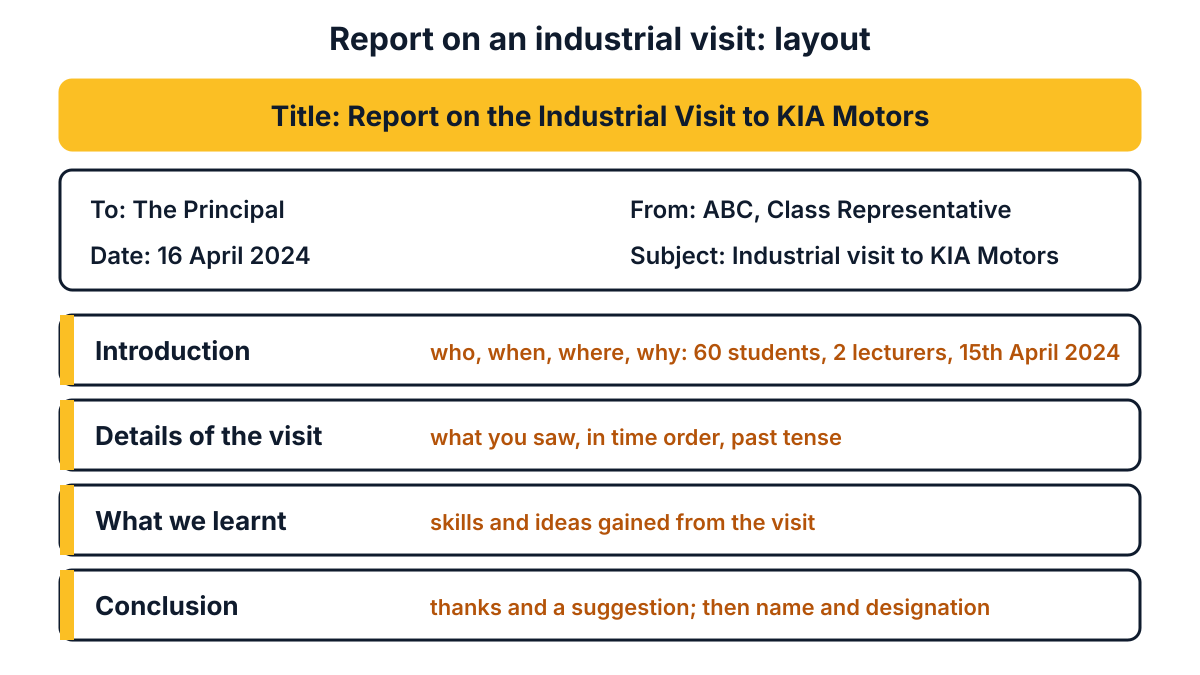
Figure: write the heading block first, then the four sections of the report.
Report on the Industrial Visit to KIA Motors
To: The Principal, XYZ Government Polytechnic From: ABC, Class Representative, First Year DEEE Date: 16 April 2024 Subject: Report on the industrial visit to KIA Motors
Introduction As part of our curriculum, our class of 60 students visited the KIA Motors car manufacturing plant on 15th April 2024. Two lecturers of our department accompanied us. The aim of the visit was to see how a modern automobile plant works.
Details of the visit We left the college by bus early in the morning and reached the plant by ten o’clock. The plant officials welcomed us and gave a short talk on safety rules. We were given helmets and safety glasses. An engineer then took us around the press shop, the body shop, the paint shop and the assembly line. In the body shop, robots were welding car bodies with great speed and accuracy. We also saw the electrical systems and the quality checks done on each car.
What we learnt We learnt how automation, robots and electrical control systems are used in mass production. We also understood the importance of safety, teamwork and quality control in an industry.
Conclusion The visit was very useful and informative. We thank the management of KIA Motors and our lecturers. We request that such visits be arranged every year.
ABC Class Representative
What earns marks: the heading block (To, From, Date, Subject), past tense throughout, the facts given in the question (60 students, two lecturers, the date), clear section headings and a conclusion. Do not add a story; a report states facts.
Q17. (a) Write an e-mail to your friend sharing the Republic Day photographs; (b) frame three “Wh” questions and two “Yes/No” questions from the passage on Abdul Kalam (10 marks)
The paper does not print the split of marks; treat it as 5 + 5.
(a) E-mail. An e-mail has To, Cc (optional), Subject, attachment, salutation, body, closing and the sender’s name.
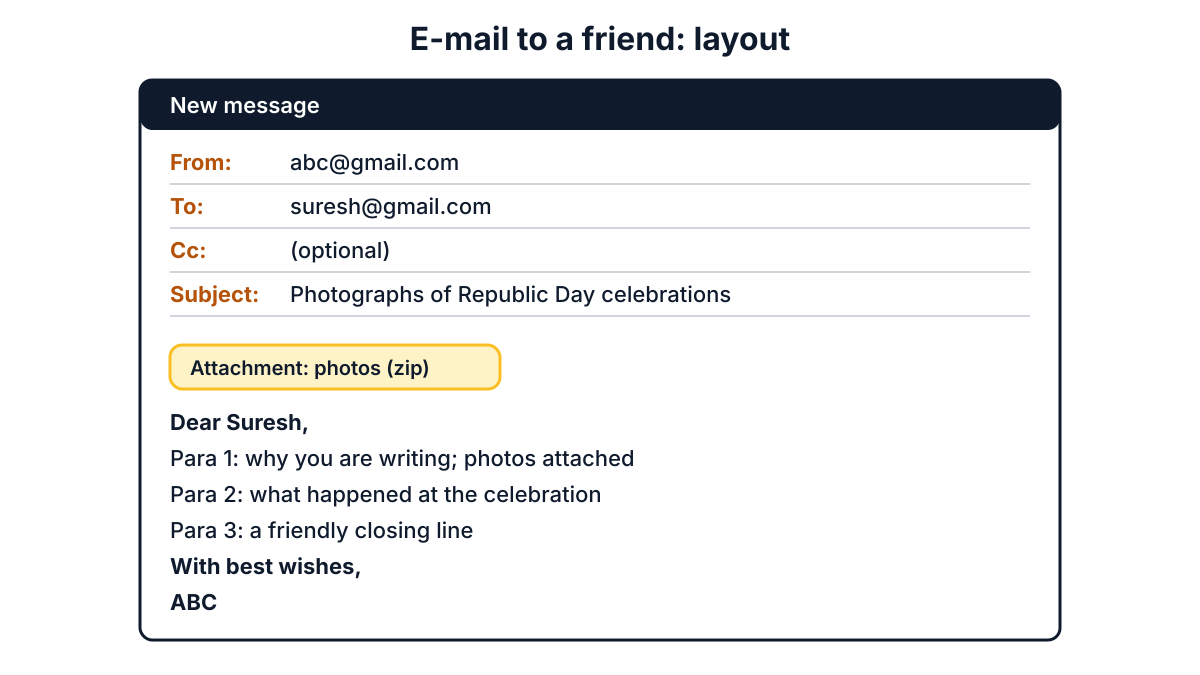
Figure: the header fields come first, then the message in short paragraphs.
From: abc@gmail.com To: suresh@gmail.com Subject: Photographs of Republic Day celebrations in our college Attachments: RepublicDay_photos.zip
Dear Suresh,
I hope you are doing well. I am sharing the photographs of the Republic Day celebrations held in our college. Please find them attached to this mail.
Our Principal hoisted the national flag, and the NCC cadets gave a smart march past. Students performed patriotic songs and a skit on the Constitution. I also took part in the group song. The photos of the flag hoisting and the cultural programme came out very well.
Do share the photos of your college celebrations too.
With best wishes, ABC
What earns marks: a clear subject line, mention of the attachment, a friendly but correct tone, short paragraphs, and a proper closing.
(b) Questions from the passage. A Wh question starts with what, where, which, who, why or how and asks for information. A Yes/No question starts with a helping verb (is, was, did, has) and is answered yes or no.
| Type | Question | Answer from the passage |
|---|---|---|
| Wh | Where was Abdul Kalam born? | In Rameswaram, a small town in Tamil Nadu. |
| Wh | Which role did Abdul Kalam love the most? | Being a teacher and interacting with young people. |
| Wh | Which books did Abdul Kalam write? | The Ignited Minds and Wings of Fire. |
| Yes/No | Was Abdul Kalam the President of India? | Yes, he was. |
| Yes/No | Did Abdul Kalam work as the Director of DRDO? | Yes, he did. |
Key points to write: put the helping verb before the subject and end every question with a question mark.
Q18. Read the passage on mobile communication and 5G in India and answer the questions (10 marks)
Answer each part in a phrase or one simple sentence, only from the passage. Each part carries 1 mark.
- (a) The passage is about the mobile communication revolution in India (5G) and its advantages and disadvantages.
- (b) IIT Madras conducted the study on mobile communication. (The question says “survey”; the passage says “study”.)
- (c) About 6 crore new connections (from 15 crore to 21 crore in two years).
- (d) Connectivity among people, education (teaching and learning) and social media.
- (e) False. Human beings also suffer from neurological diseases.
- (f) False. The passage does not say this.
- (g) True. Human beings suffer from neurological diseases due to mobile radiation.
- (h) False. The passage says technology has taken over the whole world; India is one of the countries affected.
- (i) emission
- (j) “The Mobile Revolution in India: Boon or Bane”
Note: the passage says 5G was launched in 2022 with a data speed of “up to 1 gigabyte per second”. Answer from the passage as printed; do not correct it in the exam.
Answer: (c) 21 crore - 15 crore = 6 crore new connections.
FAQ
Which Part B questions are easiest in the EE-101 English March 2025 paper?
Q18 (comprehension), Q17 (e-mail and question framing), Q15 (letter) and Q16 (report) follow fixed formats, so they are the safest. Add Q12 (ATM instructions) or Q11 (paragraph) as the fifth.
How are marks given in the SBTET English Part A?
Each Part A question carries 3 marks, usually 1 mark per sentence or blank. Marks are given only for the correct form, so spelling and the exact verb form matter.
Which grammar topics came in the C-23 English paper of March 2025?
Articles, prepositions, helping verbs, modals, tenses, voice, degrees of comparison, negatives and requests, sentence synthesis, reported speech and subject-verb agreement.
Should I write my own name in a letter or report in the board exam?
No. Use a dummy name such as ABC and a dummy college name such as XYZ Polytechnic, so that your script cannot be identified.
Sources
- AP SBTET C-23 DEEE EE-101 question paper, Mar-Apr 2025
- C-23 Curriculum, Diploma in Electrical and Electronics Engineering, SBTET AP
- Prescribed textbook: INTERACT (A Text book of English for I Year Engineering Diploma Courses), SBTET AP
- Reference books (C-23 syllabus):
- Martin Hewings: Advanced Grammar in Use, Cambridge University Press
- Raymond Murphy: English Grammar in Use, Cambridge University Press
- Sidney Greenbaum: Oxford English Grammar, Oxford University Press
- Wren and Martin (rev. N.D.V. Prasad Rao): English Grammar and Composition, S. Chand
- Sarah Freeman: Strengthen Your Writing, Macmillan
- Past habits: used to, would and the past simple
- Future continuous and future perfect
- Present perfect simple and continuous
- Reported speech: questions
Writes and reviews the SBTET EEE Papers solutions: AP SBTET diploma question papers answered step by step from the prescribed syllabus.