EE-102 Engineering Mathematics-I Mar-Apr 2025 paper solved: Cramer's rule, parabola from focus and directrix, maxima and minima
 Nookesh Karri ·· 23 min read

This post solves the Engineering Mathematics 1 question paper of March 2025 (AP SBTET C-23, EE-102, common first year paper 23006) question by question. The paper has 10 three-mark questions in Part A and 8 ten-mark questions in Part B, of which you answer any five. You can see the original March/April 2025 question paper here; every answer below follows the method the C-23 syllabus teaches and was checked with python.
Engineering Mathematics 1 question paper March 2025: pattern and syllabus units
The EE-102 March 2025 paper follows the usual C-23 pattern: 3 hours, 80 marks, Part A 10 × 3 = 30 (answer all) and Part B 5 × 10 = 50 (answer any five of eight). The table maps each question to its unit in the C-23 DEEE curriculum.
| Q no | Topic | Syllabus unit | Marks |
|---|---|---|---|
| 1 | Range of a function | Unit I: Algebra (Functions) | 3 |
| 2 | Partial fractions | Unit I: Algebra (Partial fractions) | 3 |
| 3 | Difference of matrices | Unit I: Algebra (Matrices) | 3 |
| 4 | Adjoint of a 2 × 2 matrix | Unit I: Algebra (Matrices) | 3 |
| 5 | (cos 6° − sin 6°)/(cos 6° + sin 6°) = tan 39° | Unit II: Trigonometry (Compound angles) | 3 |
| 6 | Value of sin 15° | Unit II: Trigonometry (Compound angles) | 3 |
| 7 | Modulus of a complex number | Unit II: Trigonometry (Complex numbers) | 3 |
| 8 | Line through two points | Unit III: Co-ordinate Geometry (Straight lines) | 3 |
| 9 | Limit of sin 5x / sin 3x | Unit IV: Differential Calculus (Limits) | 3 |
| 10 | Derivative of a polynomial | Unit IV: Differential Calculus (Differentiation) | 3 |
| 11 | Cramer’s rule | Unit I: Algebra (Determinants) | 10 |
| 12 | Transformations; inverse trig functions | Unit II: Trigonometry | 5 + 5 |
| 13 | Trig equation; area of a triangle | Unit II: Trigonometry | 5 + 5 |
| 14 | Circle on a diameter; parabola from focus and directrix | Unit III: Co-ordinate Geometry | 5 + 5 |
| 15 | Derivatives of sum and product | Unit IV: Differential Calculus | 5 + 5 |
| 16 | Logarithmic differentiation; second derivative | Unit IV: Differential Calculus | 5 + 5 |
| 17 | Tangent and normal slopes; velocity and acceleration | Unit V: Applications of Derivatives | 5 + 5 |
| 18 | Maxima and minima; errors | Unit V: Applications of Derivatives | 5 + 5 |
Part B questions with (a) and (b) carry 10 marks in total; the paper does not print the split, so 5 + 5 is assumed. All five units appear in Part B, so you cannot skip any unit. Practice papers of other sessions are listed on the Engineering Mathematics-I subject page.
Q1. If A = {−1, 0, 1} and f : A → B is a function such that f(x) = x² + 1, then find the range of f. (3 marks)
The range is the set of images f(x) of all elements of A.
- f(−1) = (−1)² + 1 = 2
- f(0) = 0² + 1 = 1
- f(1) = 1² + 1 = 2
The images are 2, 1 and 2. In a set, a repeated element is written once.
Answer: Range of f = {1, 2}
Q2. Resolve x / ((x + 1)(x − 8)) into partial fractions. (3 marks)
The denominator has two distinct linear factors, so each gets one constant.
- Let x / ((x + 1)(x − 8)) = A/(x + 1) + B/(x − 8).
- Multiply by (x + 1)(x − 8): x = A(x − 8) + B(x + 1).
- Put x = −1: −1 = A(−9), so A = 1/9.
- Put x = 8: 8 = B(9), so B = 8/9.
Answer: x / ((x + 1)(x − 8)) = 1 / (9(x + 1)) + 8 / (9(x − 8))
Q3. If A = [2 4 −1; 4 4 5] and B = [4 0 1; 2 −4 −4], then find A − B. (3 marks)
Both matrices are of order 2 × 3, so A − B exists. Subtract each element of B from the element of A in the same place. (The PDF of this paper prints the matrix entries in a font that does not show in every viewer; the entries are A = [2 4 −1; 4 4 5] and B = [4 0 1; 2 −4 −4].)
| A − B | Column 1 | Column 2 | Column 3 |
|---|---|---|---|
| Row 1 | 2 − 4 = −2 | 4 − 0 = 4 | −1 − 1 = −2 |
| Row 2 | 4 − 2 = 2 | 4 − (−4) = 8 | 5 − (−4) = 9 |
Answer: A − B = [−2 4 −2; 2 8 9], a 2 × 3 matrix.
Q4. If A = [2 1; 1 2], then find adj A. (3 marks)
The adjoint is the transpose of the cofactor matrix. For A = [a b; c d], adj A = [d −b; −c a].
- Cofactors: A₁₁ = 2, A₁₂ = −1, A₂₁ = −1, A₂₂ = 2.
- Cofactor matrix = [2 −1; −1 2].
- Its transpose is the same matrix, because it is symmetric.
Check: A × adj A = [3 0; 0 3] = |A| I, and |A| = 4 − 1 = 3.
Answer: adj A = [2 −1; −1 2]
Q5. Prove that (cos 6° − sin 6°) / (cos 6° + sin 6°) = tan 39°. (3 marks)
Divide the numerator and the denominator by cos 6°, then use the tan (A − B) formula with tan 45° = 1.
- LHS = (1 − tan 6°) / (1 + tan 6°)
- = (tan 45° − tan 6°) / (1 + tan 45° tan 6°)
- = tan (45° − 6°)
- = tan 39° = RHS
Q6. Find the value of sin 15°. (3 marks)
Write 15° as 45° − 30° and use sin (A − B) = sin A cos B − cos A sin B.
- sin 15° = sin (45° − 30°)
- = sin 45° cos 30° − cos 45° sin 30°
- = (1/√2)(√3/2) − (1/√2)(1/2)
- = (√3 − 1) / (2√2)
As a decimal this is about 0.2588.
Answer: sin 15° = (√3 − 1) / (2√2)
Q7. Find the modulus of the complex number (3 + i)(2 − 7i). (3 marks)
First multiply, then use |a + ib| = √(a² + b²).
- (3 + i)(2 − 7i) = 6 − 21i + 2i − 7i²
- Since i² = −1: = 6 − 19i + 7 = 13 − 19i
- Modulus = √(13² + (−19)²) = √(169 + 361) = √530
Check with |z₁z₂| = |z₁||z₂|: √10 × √53 = √530.
Answer: |(3 + i)(2 − 7i)| = √530 ≈ 23.02
Q8. Find the equation of the straight line passing through the points (1, 2) and (3, −4). (3 marks)
Use the slope of the two points, then the point-slope form.
- Slope m = (y₂ − y₁)/(x₂ − x₁) = (−4 − 2)/(3 − 1) = −6/2 = −3
- y − 2 = −3(x − 1)
- y − 2 = −3x + 3
- 3x + y − 5 = 0
Check: (3, −4) gives 9 − 4 − 5 = 0.
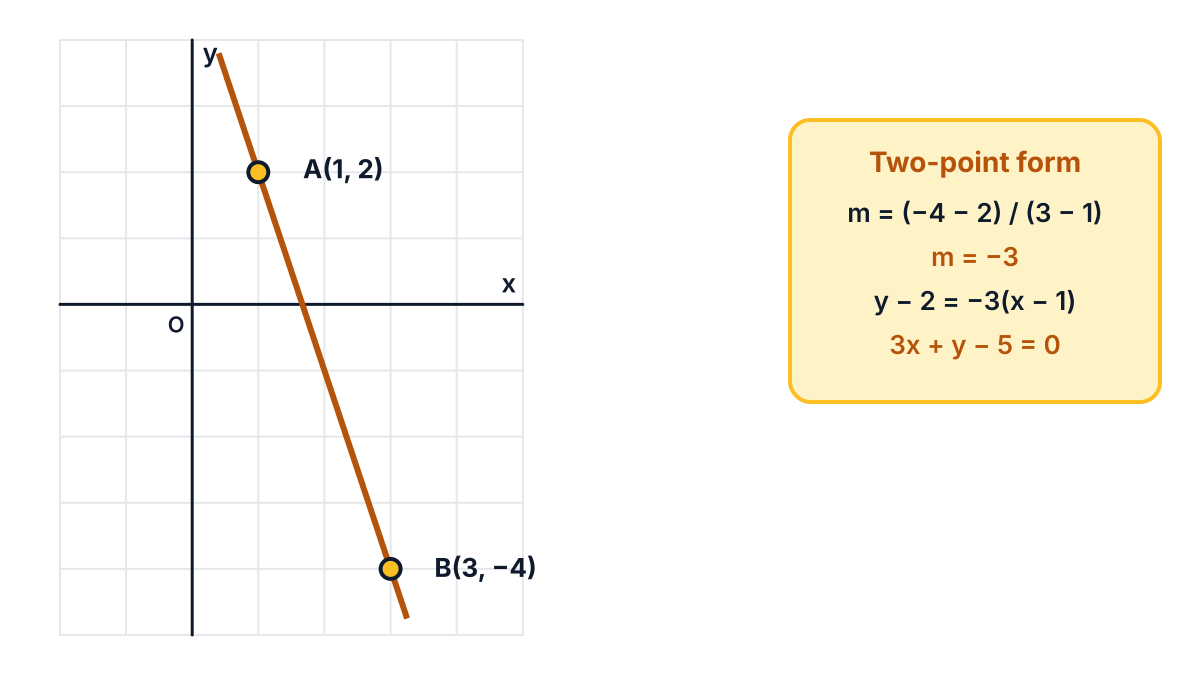
Figure: the line falls 3 units for every 1 unit to the right, so its slope is −3.
Answer: 3x + y − 5 = 0
Q9. Evaluate lim (x → 0) sin 5x / sin 3x. (3 marks)
Use the standard limit lim (θ → 0) sin θ / θ = 1 by multiplying and dividing by 5x and 3x.
- sin 5x / sin 3x = [(sin 5x / 5x) × 5x] / [(sin 3x / 3x) × 3x]
- = (sin 5x / 5x) / (sin 3x / 3x) × (5/3)
- As x → 0, both brackets tend to 1.
- Limit = 1 / 1 × 5/3 = 5/3
Answer: lim (x → 0) sin 5x / sin 3x = 5/3
Q10. Find the derivative of 5x² − 9x + 2 w.r.t. x. (3 marks)
Differentiate term by term with d/dx (xⁿ) = n xⁿ⁻¹ and d/dx (constant) = 0.
- d/dx (5x²) = 5 × 2x = 10x
- d/dx (−9x) = −9
- d/dx (2) = 0
Answer: d/dx (5x² − 9x + 2) = 10x − 9
Q11. Solve the equations by using Cramer’s rule: 3x + 2y + 2z = 5, 2x + y − z = 1 and x + y − z = 0. (10 marks)
Cramer’s rule gives x = Δx/Δ, y = Δy/Δ, z = Δz/Δ, where Δ is the determinant of the coefficients and Δx, Δy, Δz are got by replacing the x, y or z column with the constants 5, 1, 0. It works only when Δ ≠ 0.
Step 1: write the system.
| Equation | x | y | z | Constant |
|---|---|---|---|---|
| (1) | 3 | 2 | 2 | 5 |
| (2) | 2 | 1 | −1 | 1 |
| (3) | 1 | 1 | −1 | 0 |
Step 2: find Δ (expand along the first row).
- Δ = 3[(1)(−1) − (−1)(1)] − 2[(2)(−1) − (−1)(1)] + 2[(2)(1) − (1)(1)]
- = 3(−1 + 1) − 2(−2 + 1) + 2(2 − 1)
- = 3(0) − 2(−1) + 2(1)
- = 0 + 2 + 2 = 4
Since Δ = 4 ≠ 0, the system has a unique solution.
Step 3: find Δx (first column replaced by 5, 1, 0).
- Δx = 5[(1)(−1) − (−1)(1)] − 2[(1)(−1) − (−1)(0)] + 2[(1)(1) − (1)(0)]
- = 5(0) − 2(−1) + 2(1)
- = 0 + 2 + 2 = 4
Step 4: find Δy (second column replaced by 5, 1, 0).
- Δy = 3[(1)(−1) − (−1)(0)] − 5[(2)(−1) − (−1)(1)] + 2[(2)(0) − (1)(1)]
- = 3(−1) − 5(−1) + 2(−1)
- = −3 + 5 − 2 = 0
Step 5: find Δz (third column replaced by 5, 1, 0).
- Δz = 3[(1)(0) − (1)(1)] − 2[(2)(0) − (1)(1)] + 5[(2)(1) − (1)(1)]
- = 3(−1) − 2(−1) + 5(1)
- = −3 + 2 + 5 = 4
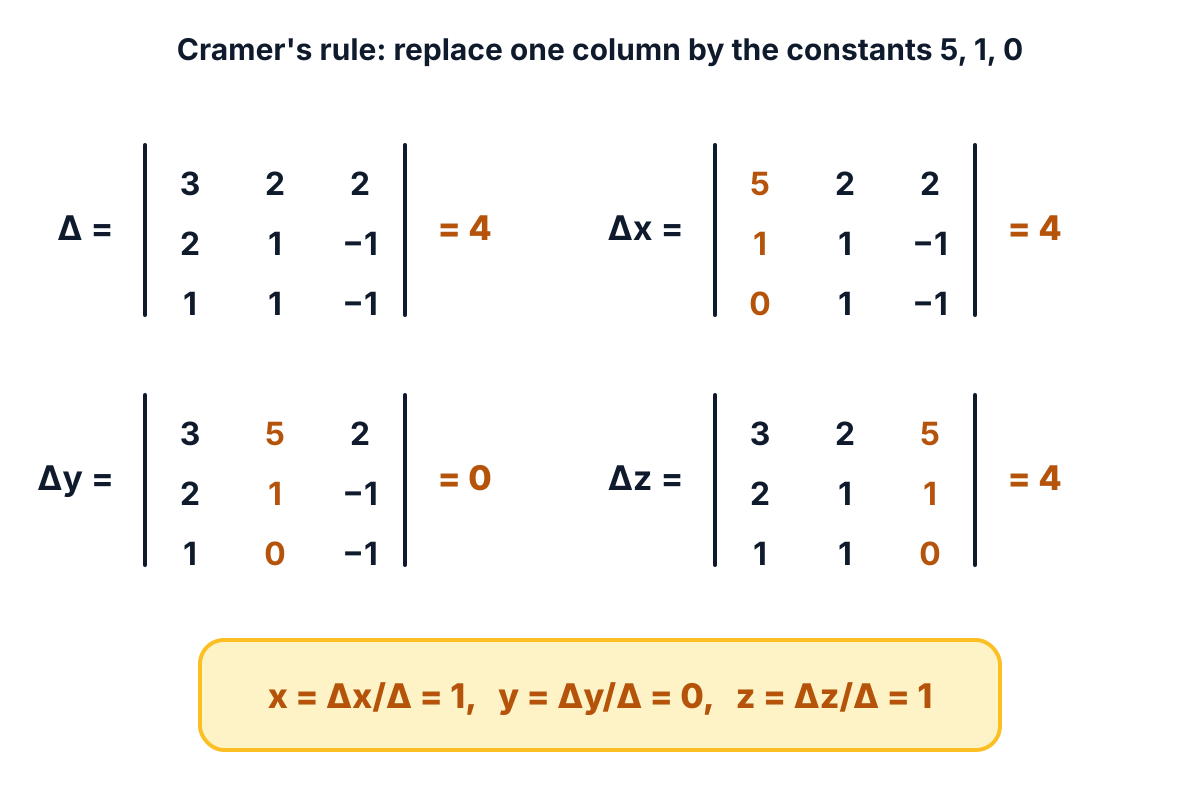
Figure: each of Δx, Δy and Δz is Δ with one column swapped for the constants 5, 1, 0.
Step 6: apply Cramer’s rule.
- x = Δx/Δ = 4/4 = 1
- y = Δy/Δ = 0/4 = 0
- z = Δz/Δ = 4/4 = 1
Step 7: check in all three equations.
- 3(1) + 2(0) + 2(1) = 5 ✓
- 2(1) + 0 − 1 = 1 ✓
- 1 + 0 − 1 = 0 ✓
Exam tip: Δy = 0 does not mean “no solution”. Only Δ = 0 is a problem. Here Δ = 4, so y = 0 is a correct value.
Answer: x = 1, y = 0, z = 1
Q12. (a) Prove that sin 50° − sin 70° + sin 10° = 0. (b) Prove that tan⁻¹(1/2) − tan⁻¹(1/5) = tan⁻¹(3/11). (10 marks)
Part (a) uses the transformation formula for a sum of sines, and part (b) uses the difference formula for inverse tangents. Each part is taken as 5 marks.
(a) Prove that sin 50° − sin 70° + sin 10° = 0 (5 marks)
Formula: sin C + sin D = 2 sin ((C + D)/2) cos ((C − D)/2).
- LHS = (sin 50° + sin 10°) − sin 70°
- sin 50° + sin 10° = 2 sin ((50° + 10°)/2) cos ((50° − 10°)/2)
- = 2 sin 30° cos 20°
- = 2 × (1/2) × cos 20° = cos 20°
- sin 70° = sin (90° − 20°) = cos 20°
- LHS = cos 20° − cos 20° = 0 = RHS
Hence proved.
(b) Prove that tan⁻¹(1/2) − tan⁻¹(1/5) = tan⁻¹(3/11) (5 marks)
Formula: tan⁻¹x − tan⁻¹y = tan⁻¹((x − y)/(1 + xy)), valid here because x = 1/2 and y = 1/5 are positive.
- Put x = 1/2 and y = 1/5.
- x − y = 1/2 − 1/5 = (5 − 2)/10 = 3/10
- 1 + xy = 1 + (1/2)(1/5) = 1 + 1/10 = 11/10
- (x − y)/(1 + xy) = (3/10) ÷ (11/10) = 3/11
- So LHS = tan⁻¹(3/11) = RHS
Hence proved.
Q13. (a) Solve 2cos²θ − 3cos θ + 1 = 0. (b) Find the area of the triangle ABC when a = 3, b = 6, c = 7. (10 marks)
Part (a) is a quadratic in cos θ, solved by factorising and then writing the general solution. Part (b) uses Hero’s formula, because all three sides are given. Each part is taken as 5 marks.
(a) Solve 2cos²θ − 3cos θ + 1 = 0 (5 marks)
- Factorise: 2cos²θ − 2cos θ − cos θ + 1 = 0
- 2cos θ (cos θ − 1) − 1(cos θ − 1) = 0
- (2cos θ − 1)(cos θ − 1) = 0
- So cos θ = 1/2 or cos θ = 1.
General solution of cos θ = cos α is θ = 2nπ ± α, n ∈ Z.
- cos θ = 1/2 = cos (π/3), so θ = 2nπ ± π/3.
- cos θ = 1 = cos 0, so θ = 2nπ.
In 0 ≤ θ < 2π the solutions are θ = 0, π/3 and 5π/3.
Answer (a): θ = 2nπ ± π/3 or θ = 2nπ, where n is any integer
(b) Area of triangle ABC when a = 3, b = 6, c = 7 (5 marks)
Hero’s formula: Δ = √(s(s − a)(s − b)(s − c)), where s = (a + b + c)/2.
- s = (3 + 6 + 7)/2 = 16/2 = 8
- s − a = 8 − 3 = 5
- s − b = 8 − 6 = 2
- s − c = 8 − 7 = 1
- Δ = √(8 × 5 × 2 × 1) = √80
- = √(16 × 5) = 4√5
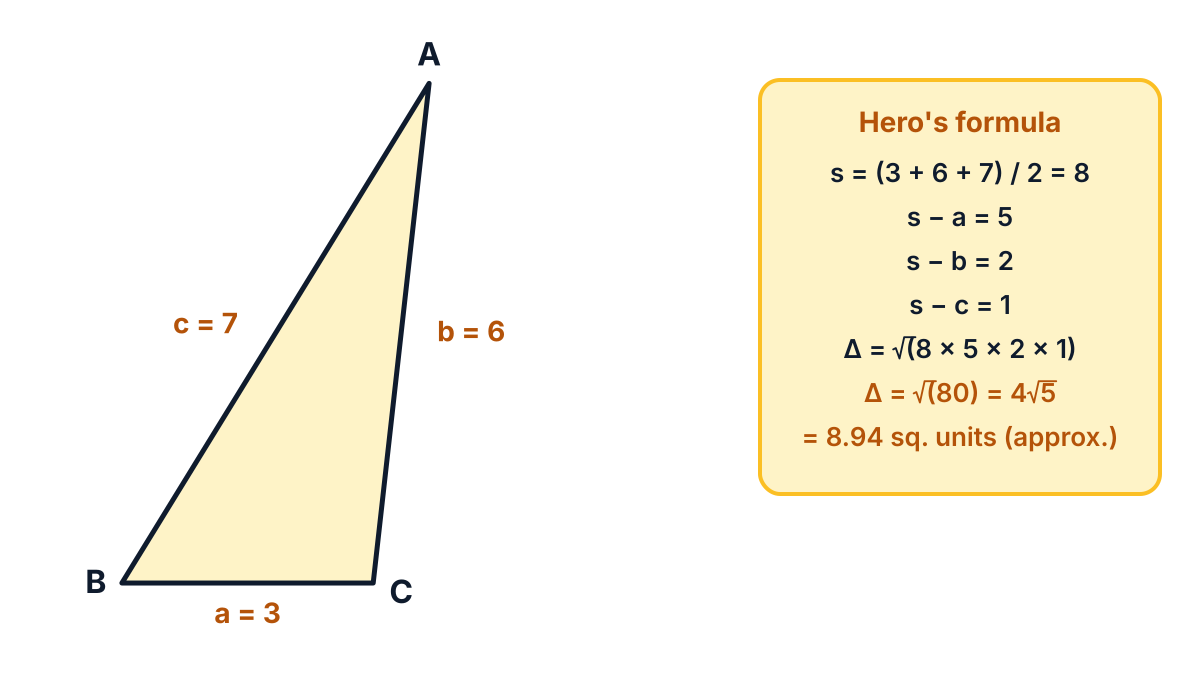
Figure: side a is opposite A, so BC = 3, CA = 6 and AB = 7.
Answer (b): Area = 4√5 ≈ 8.94 square units
Q14. (a) Find the equation of the circle having (1, 2) and (−2, 3) as the end points of its diameter. (b) Find the equation of the parabola whose focus is (5, 0) and directrix is x + y + 1 = 0. (10 marks)
Part (a) uses the diameter form of a circle, and part (b) uses the focus-directrix definition of a conic with eccentricity e = 1. Each part is taken as 5 marks.
(a) Circle with (1, 2) and (−2, 3) as ends of a diameter (5 marks)
Diameter form: (x − x₁)(x − x₂) + (y − y₁)(y − y₂) = 0.
- (x − 1)(x + 2) + (y − 2)(y − 3) = 0
- (x² + x − 2) + (y² − 5y + 6) = 0
- x² + y² + x − 5y + 4 = 0
Check: centre (−g, −f) = (−1/2, 5/2), the midpoint of the two ends. Radius = √(g² + f² − c) = √(1/4 + 25/4 − 4) = √10 / 2.
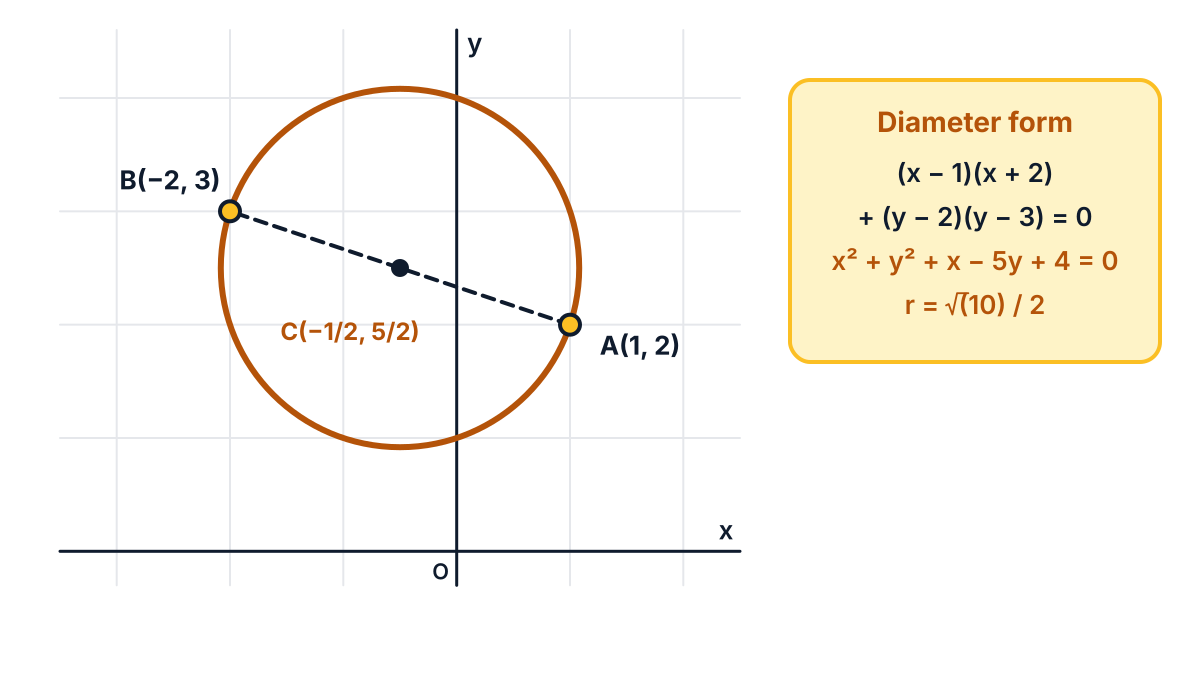
Figure: the centre is the midpoint of AB, and both ends lie on the circle.
Answer (a): x² + y² + x − 5y + 4 = 0
(b) Parabola with focus S(5, 0) and directrix x + y + 1 = 0 (5 marks)
For a parabola, e = 1, so every point P(x, y) on it satisfies SP = PM, where PM is the perpendicular distance from P to the directrix.
- SP = √((x − 5)² + (y − 0)²)
- PM = |x + y + 1| / √(1² + 1²) = |x + y + 1| / √2
- SP = PM, so SP² = PM²: (x − 5)² + y² = (x + y + 1)² / 2
- 2[(x − 5)² + y²] = (x + y + 1)²
- 2x² − 20x + 50 + 2y² = x² + y² + 1 + 2xy + 2x + 2y
- x² + y² − 2xy − 22x − 2y + 49 = 0
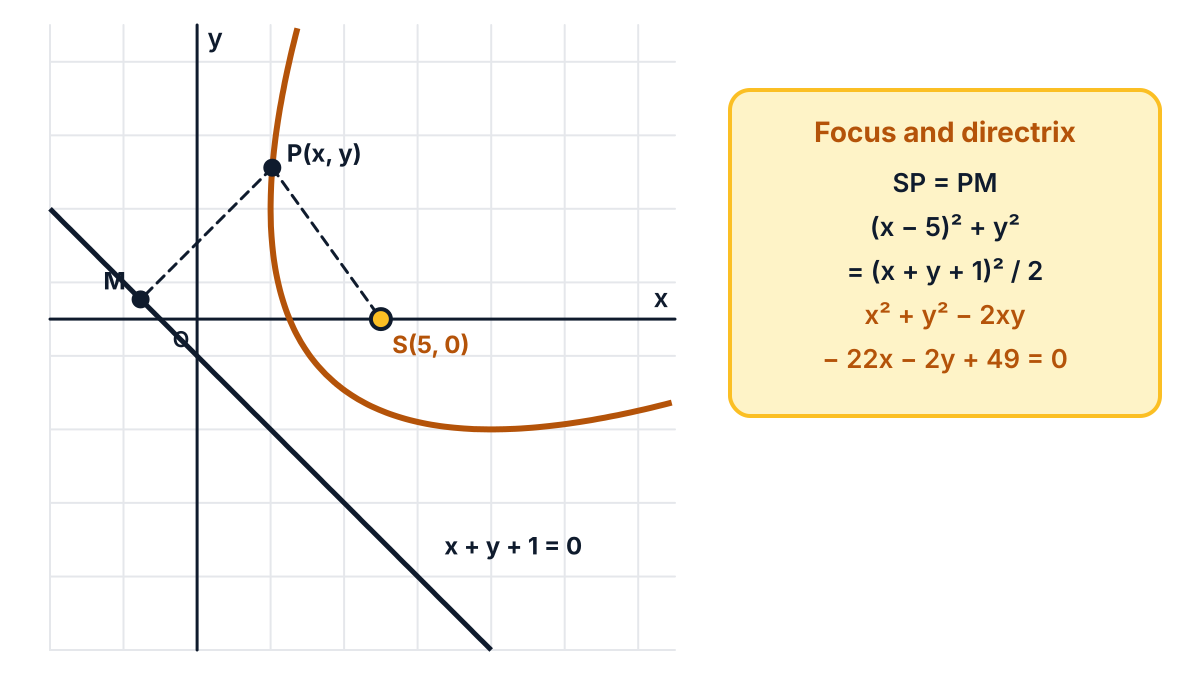
Figure: the directrix is slanted, so the parabola’s axis is slanted too and the equation has an xy term.
Exam tip: do not forget the √2 in PM. Squaring gives a 2 in the denominator, which is why the left side is multiplied by 2.
Answer (b): x² + y² − 2xy − 22x − 2y + 49 = 0
Q15. (a) Find the derivative of 3 sin x − cos x + log x with respect to x. (b) Find the derivative of x log x with respect to x. (10 marks)
Part (a) uses the sum and difference rule with standard derivatives, and part (b) uses the product rule. Each part is taken as 5 marks.
(a) d/dx (3 sin x − cos x + log x) (5 marks)
Standard results: d/dx (sin x) = cos x, d/dx (cos x) = −sin x, d/dx (log x) = 1/x.
- Let y = 3 sin x − cos x + log x.
- dy/dx = 3 d/dx (sin x) − d/dx (cos x) + d/dx (log x)
- = 3 cos x − (−sin x) + 1/x
- = 3 cos x + sin x + 1/x
Answer (a): dy/dx = 3 cos x + sin x + 1/x
(b) d/dx (x log x) (5 marks)
Product rule: d/dx (uv) = u (dv/dx) + v (du/dx).
- Let u = x and v = log x.
- du/dx = 1 and dv/dx = 1/x.
- dy/dx = x × (1/x) + log x × 1
- = 1 + log x
Answer (b): dy/dx = 1 + log x
Q16. (a) If y = xˣ, then find dy/dx. (b) If y = a cos x + b sin x, then prove that d²y/dx² + y = 0. (10 marks)
Part (a) needs logarithmic differentiation, because both the base and the power contain x. Part (b) needs the second derivative. Each part is taken as 5 marks.
(a) y = xˣ (5 marks)
- Take log on both sides: log y = x log x.
- Differentiate w.r.t. x: (1/y)(dy/dx) = x × (1/x) + log x × 1
- (1/y)(dy/dx) = 1 + log x
- dy/dx = y (1 + log x)
- dy/dx = xˣ (1 + log x)
Exam tip: xˣ is neither xⁿ (power rule) nor aˣ (exponential rule). Using either rule here gets zero marks. Take logs first.
Answer (a): dy/dx = xˣ (1 + log x)
(b) y = a cos x + b sin x; prove d²y/dx² + y = 0 (5 marks)
- y = a cos x + b sin x
- dy/dx = −a sin x + b cos x
- d²y/dx² = −a cos x − b sin x
- d²y/dx² = −(a cos x + b sin x) = −y
- So d²y/dx² + y = 0
Hence proved.
Q17. (a) Find the slopes of the tangent and normal to the curve y = x² + 2 at (0, 2). (b) If s(t) = t² + 2t + 3 is a displacement of a particle, then find its velocity and acceleration at t = 3 sec. (10 marks)
The slope of the tangent at a point is dy/dx at that point, and the slope of the normal is −1/(dy/dx). Velocity is ds/dt and acceleration is d²s/dt². Each part is taken as 5 marks.
(a) Slopes of tangent and normal to y = x² + 2 at (0, 2) (5 marks)
- dy/dx = 2x
- At (0, 2): m = 2(0) = 0
- Slope of the tangent = 0, so the tangent is horizontal: y = 2.
- Slope of the normal = −1/m = −1/0, which is not defined.
- So the normal is vertical (parallel to the y-axis): x = 0.
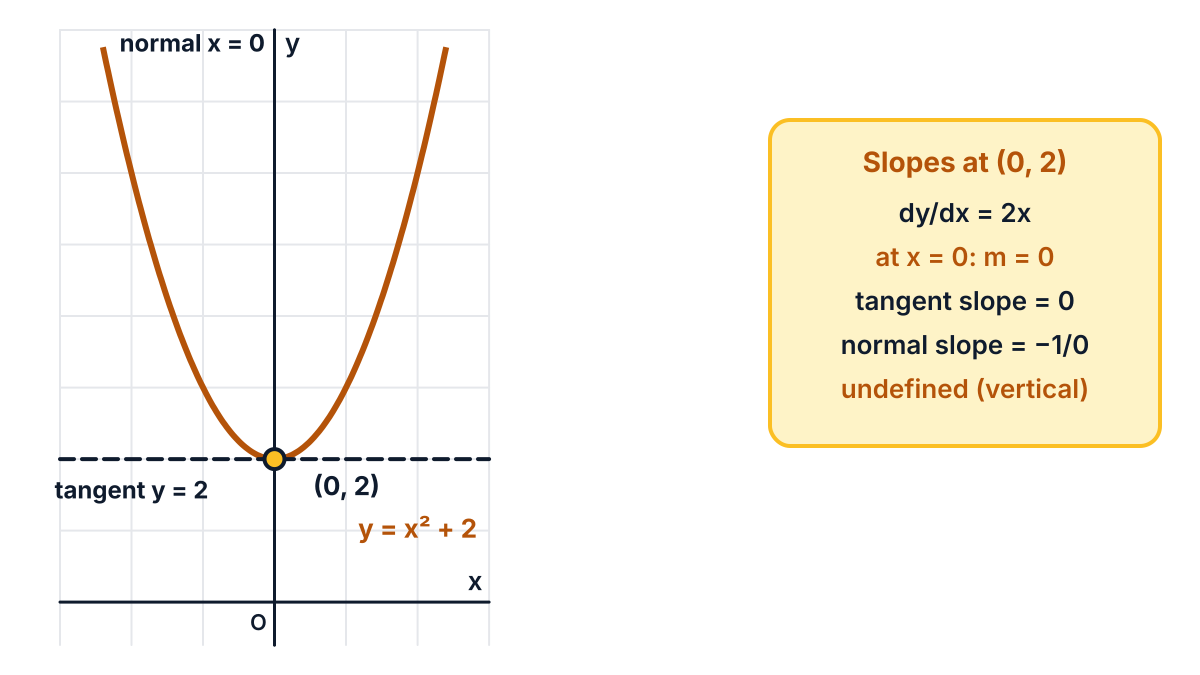
Figure: (0, 2) is the lowest point of the curve, so the tangent is flat and the normal is the y-axis.
Exam tip: do not write “slope of normal = 0” or “∞ = answer” without words. Write that the slope is undefined and the normal is the vertical line x = 0.
Answer (a): Slope of tangent = 0; slope of normal is undefined (normal is the line x = 0)
(b) Velocity and acceleration at t = 3 s (5 marks)
- s = t² + 2t + 3
- Velocity v = ds/dt = 2t + 2
- At t = 3: v = 2(3) + 2 = 8 units/s
- Acceleration a = dv/dt = d²s/dt² = 2
- At t = 3: a = 2 units/s² (it is constant for all t)
The paper gives no unit for s, so the answer is in units of length per second.
Answer (b): Velocity = 8 units/s, acceleration = 2 units/s² at t = 3 s
Q18. (a) Find the maximum or minimum value of the function f(x) = (x − 2)(2x + 1). (b) The side of a square plate is measured as 5 cm instead of 5.03 cm. Find the approximate percentage error in its perimeter. (10 marks)
Part (a) uses the first and second derivative test. Part (b) uses differentials: δP ≈ (dP/dx) δx. Each part is taken as 5 marks.
(a) Maximum or minimum of f(x) = (x − 2)(2x + 1) (5 marks)
- f(x) = 2x² + x − 4x − 2 = 2x² − 3x − 2
- f′(x) = 4x − 3
- For a turning point, f′(x) = 0: 4x − 3 = 0, so x = 3/4.
- f″(x) = 4, which is positive.
- Since f″(3/4) > 0, f has a minimum at x = 3/4.
- Minimum value f(3/4) = 2(9/16) − 3(3/4) − 2 = 9/8 − 18/8 − 16/8 = −25/8
There is no maximum value, because the graph is an upward parabola.
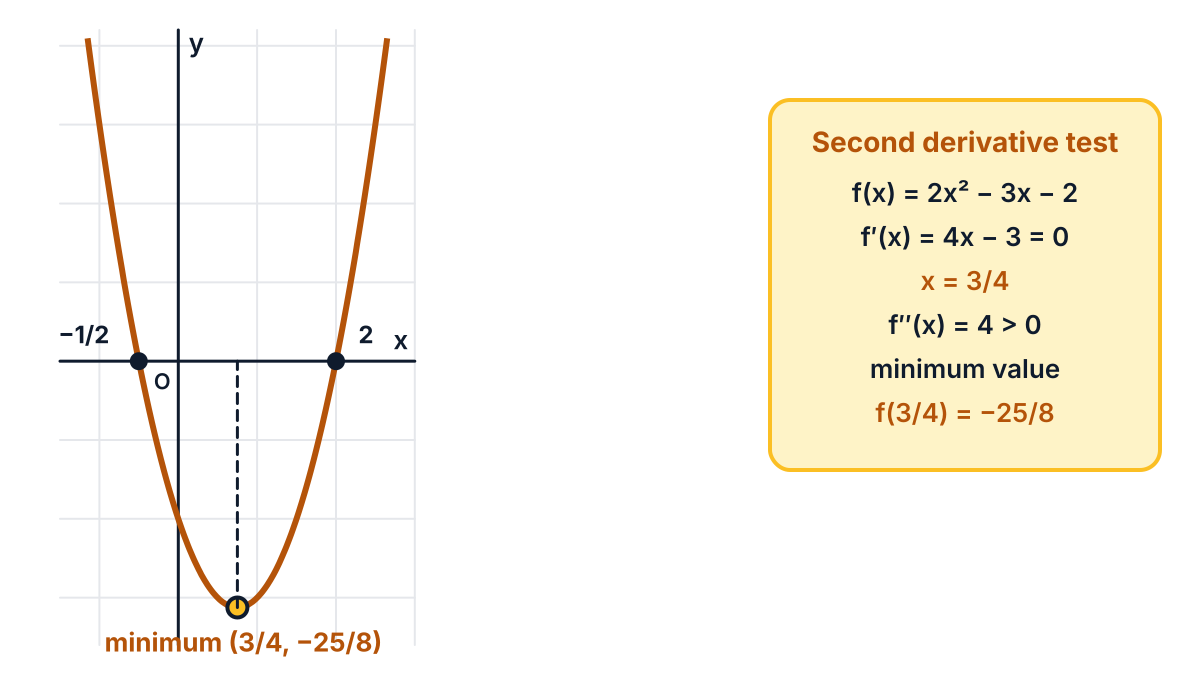
Figure: the lowest point lies halfway between the roots −1/2 and 2, at x = 3/4.
Answer (a): Minimum value = −25/8 (that is −3.125) at x = 3/4; no maximum
(b) Percentage error in the perimeter (5 marks)
- Let side = x. Perimeter P = 4x.
- Measured side x = 5 cm. Error in the side δx = 5.03 − 5 = 0.03 cm.
- δP ≈ (dP/dx) δx = 4 × 0.03 = 0.12 cm
- P = 4 × 5 = 20 cm
- Percentage error = (δP / P) × 100 = (0.12 / 20) × 100 = 0.6%
A quicker check: for P = 4x, (δP/P) × 100 = (δx/x) × 100 = (0.03/5) × 100 = 0.6%.
Exam tip: the method uses the measured value x = 5 cm as the base. If you divide by the true perimeter 20.12 cm instead, you get about 0.596%, which still rounds to 0.6%.
Answer (b): Approximate percentage error in the perimeter = 0.6%
My advice: in Part B, pick Q15, Q16 and Q17 first, because each part needs only one or two derivatives. Then add Q11, since Cramer’s rule is pure routine once you expand determinants carefully, and Q18. Leave Q14(b) for last; the slanted directrix makes the algebra longer than it looks.
FAQ
Which units carry the most marks in the EE-102 March 2025 paper?
Unit II (Trigonometry) carries the most: Q5, Q6 and Q7 in Part A plus Q12 and Q13 in Part B. Unit IV (Differential Calculus) is next with Q9, Q10, Q15 and Q16.
Which Part B questions are the easiest to score in this paper?
Q15 and Q16 are direct differentiation, Q17 needs only one derivative per part, and Q11 is a standard Cramer’s rule sum with small numbers. These four plus Q18 are a safe choice of five.
How should I write Cramer’s rule answers to get full marks?
Write the system, the coefficient determinant Δ with its expansion, then Δx, Δy and Δz each with its expansion, then x = Δx/Δ, y = Δy/Δ, z = Δz/Δ, and finally check the answer in one equation.
Is the answer to Q18(b) 0.6% or 0.596%?
The approximation method uses dP/P × 100 with the measured side 5 cm, which gives 0.6%. Taking the true perimeter 20.12 cm as the base gives about 0.596%, which also rounds to 0.6%.
Sources
- AP SBTET C-23 DEEE EE-102 question paper, Mar-Apr 2025
- C-23 Curriculum, Diploma in Electrical and Electronics Engineering, SBTET AP
- Prescribed textbook: Engineering Mathematics-I, textbook for first year diploma courses, prepared and prescribed by SBTET AP
- Reference books (C-23 syllabus):
- Shanti Narayan: A Textbook of Matrices, S. Chand
- Moyer & Ayres: Schaum’s Outline of Trigonometry, 4th ed.
- Thomas & Finney: Calculus and Analytic Geometry, 9th ed., Addison Wesley
- Ayres & Mendelson: Schaum’s Outline of Calculus
- M. Vygodsky: Mathematical Handbook, Mir Publishers
Writes and reviews the SBTET EEE Papers solutions: AP SBTET diploma question papers answered step by step from the prescribed syllabus.