EE-106 Basic Electrical Technology Mar-Apr 2025 paper solved: KVL circuit, electricity bill and superposition theorem
 Nookesh Karri ·· 25 min read

This post solves the AP SBTET C-23 DEEE first year basic electrical technology question paper of March 2025 (EE-106, March/April 2025 board exam). It answers all 10 Part A questions and all 8 Part B questions, with every sum recomputed and a code-drawn diagram for each circuit. You can open the original question paper PDF next to this page and check each answer.
Basic Electrical Technology question paper March 2025: pattern and syllabus units
The EE-106 paper of March 2025 follows the usual C-23 pattern: 3 hours, 80 marks, Part A with 10 questions of 3 marks (30 marks, all compulsory) and Part B with 8 questions of 10 marks, of which you answer any five (50 marks). The questions map exactly onto the unit blueprint of the C-23 curriculum: 3, 1, 3, 1 and 2 short questions, and 1, 2, 2, 1 and 2 essay questions from Units 1 to 5.
| Q no | Topic | Syllabus unit | Marks |
|---|---|---|---|
| 1 | Electric current and potential | Unit 1 Basic Principles of Electricity | 3 |
| 2 | Limitations of Ohm’s law | Unit 1 | 3 |
| 3 | Temperature coefficient of resistance | Unit 1 | 3 |
| 4 | Junction and loop | Unit 2 Resistive Circuits | 3 |
| 5 | Electrical power and unit | Unit 3 Work, Power, Energy and Heating | 3 |
| 6 | Joule’s law of heating | Unit 3 | 3 |
| 7 | Resistance and current of a 60 W lamp | Unit 3 | 3 |
| 8 | Ideal current source | Unit 4 Conversion Techniques | 3 |
| 9 | Need for network theorems | Unit 5 Network Theorems | 3 |
| 10 | Maximum power transfer theorem | Unit 5 | 3 |
| 11 | Laws of resistance, nichrome wire length | Unit 1 | 10 |
| 12 | Series vs parallel, series circuit sum | Unit 2 | 10 |
| 13 | KVL (branch current) problem | Unit 2 | 10 |
| 14 | Monthly electricity bill | Unit 3 | 10 |
| 15 | Electric cooker, heat to warm water | Unit 3 | 10 |
| 16 | Star to delta transformation | Unit 4 | 10 |
| 17 | Thevenin’s theorem | Unit 5 | 10 |
| 18 | Superposition theorem problem | Unit 5 | 10 |
In Part B, pick the five numerical questions you can check yourself (Q12, Q13, Q14, Q18, and Q11 or Q16). A sum with a checked final answer beats a long theory answer that a valuer can mark down for missing points.
Q1. Define electric current and electric potential. (3 marks)
Electric current is the rate of flow of electric charge through a conductor. If a charge Q coulombs passes a cross-section in t seconds, the current is I = Q / t. Its unit is the ampere (A); 1 A = 1 coulomb per second.
Electric potential at a point is the work done in bringing a unit positive charge from infinity to that point against the electric field. V = W / Q, and its unit is the volt (V); 1 V = 1 joule per coulomb.
Key points to write: I = Q/t in amperes; V = W/Q in volts; current flows from higher to lower potential in the external circuit.
Q2. List any five limitations of Ohm’s law. (3 marks)
Ohm’s law (V = IR) holds only when the temperature and other physical conditions stay constant. Its main limitations are:
- It does not apply when the temperature of the conductor changes, because the resistance then changes.
- It does not apply to non-linear devices such as diodes, transistors and thermistors.
- It does not apply to unilateral networks, where current behaves differently in the two directions.
- It does not apply to arc lamps, vacuum tubes and gas discharge tubes.
- It does not apply to electrolytes where gases are produced at the electrodes.
Key points to write: constant temperature needed; fails for non-linear, unilateral, arc and electrolytic cases.
Q3. Define temperature coefficient of resistance. (3 marks)
The temperature coefficient of resistance of a material is the change in resistance per ohm per degree Celsius rise in temperature. If R₀ is the resistance at 0 °C and Rₜ at t °C, then
α₀ = (Rₜ − R₀) / (R₀ × t), so that Rₜ = R₀ (1 + α₀ t).
Its unit is per °C (/°C). Pure metals such as copper have a positive α (resistance rises with temperature). Carbon, insulators and electrolytes have a negative α.
Key points to write: change in resistance per ohm per °C; α₀ = (Rₜ − R₀)/(R₀t); unit /°C.
Q4. Write about junction and loop in electrical network. (3 marks)
A junction (node) is a point in a network where three or more conductors meet. Current divides or combines at a junction, which is why Kirchhoff’s current law is written at junctions: the currents entering equal the currents leaving.
A loop is any closed path in a network that starts at one point, passes through elements and returns to the same point without passing any point twice. Kirchhoff’s voltage law is written around loops: the sum of EMFs equals the sum of IR drops. In the Q13 circuit below, B and E are junctions and the two windows are loops.
Key points to write: junction = meeting point of three or more branches (KCL); loop = closed path (KVL).
Q5. Define electrical power and give its unit. (3 marks)
Electrical power is the rate at which electrical work is done, or the rate at which electrical energy is converted into another form. P = W / t = V × I. Using Ohm’s law, P = I²R = V²/R.
The unit of power is the watt (W). One watt is one joule per second, or the power when 1 A flows under a potential difference of 1 V. Larger units are the kilowatt (1 kW = 1000 W) and megawatt.
Key points to write: P = VI = I²R = V²/R; unit watt = J/s.
Q6. State Joule’s law of electric heating. (3 marks)
Joule’s law states that the heat produced in a conductor by an electric current is directly proportional to:
- the square of the current (I²),
- the resistance of the conductor (R), and
- the time for which the current flows (t).
So H = I²Rt joules. In calories, H = I²Rt / J, where J is the mechanical equivalent of heat. One calorie is 4.186 J, as the heat chapter of an open physics text gives through 1.00 kcal = 4186 J.
Key points to write: H ∝ I², R, t; H = I²Rt J = I²Rt/4.186 cal.
Q7. Find resistance and current drawn by a 60 W incandescent lamp from 230 V source. (3 marks)
Given: P = 60 W, V = 230 V.
- Current: I = P / V = 60 / 230 = 0.261 A.
- Resistance: R = V² / P = 230² / 60 = 52900 / 60 = 881.67 Ω.
- Check: V / R = 230 / 881.67 = 0.261 A.
Answer: R = 881.67 Ω, I = 0.261 A.
Q8. What is an ideal current source? (3 marks)
An ideal current source is a source that supplies the same constant current to any load, whatever the voltage across its terminals. The load resistance can change from zero to a very large value, but the current stays the same.
For this, the internal resistance of the source must be infinite, shown in parallel with the source. It is drawn as a circle with an arrow inside that shows the direction of current. A practical current source has a large but finite resistance in parallel, so its current falls slightly as the load grows.
Key points to write: constant current independent of terminal voltage; internal (parallel) resistance infinite.
Q9. State the need for network theorems. (3 marks)
Network theorems are needed because complex networks with many sources and loops are hard to solve by Kirchhoff’s laws alone.
- KVL and KCL give many simultaneous equations for a large network; theorems cut the work.
- Often you need the current in one branch only; Thevenin’s or Norton’s theorem gives it directly.
- When the load changes again and again, a theorem lets you find the new current without solving the whole network each time.
- Superposition lets you study the effect of each source separately.
- Maximum power transfer tells you which load takes the most power.
Key points to write: simplify analysis, single-branch current, changing loads, multiple sources.
Q10. Write the statement of maximum power transfer theorem. (3 marks)
The maximum power transfer theorem states that a resistive load connected to a DC network receives maximum power when the load resistance equals the internal (Thevenin) resistance of the network seen from the load terminals.
Condition: R_L = R_th. The maximum power is P_max = V_th² / (4 R_L). At this point the efficiency is only 50%, because equal power is lost in R_th.
Key points to write: R_L = R_th; P_max = V_th²/4R_L; efficiency 50%.
Q11. (a) State the laws of resistance and derive the formula for resistance. (b) Find the length of nichrome wire for a 3.4 Ω heater element. (10 marks)
This question has two parts: (a) for 6 marks and (b) for 4 marks.
(a) Laws of resistance. The resistance R of a conductor:
- is directly proportional to its length l: R ∝ l;
- is inversely proportional to its area of cross-section A: R ∝ 1/A;
- depends on the nature of the material;
- depends on the temperature of the conductor.
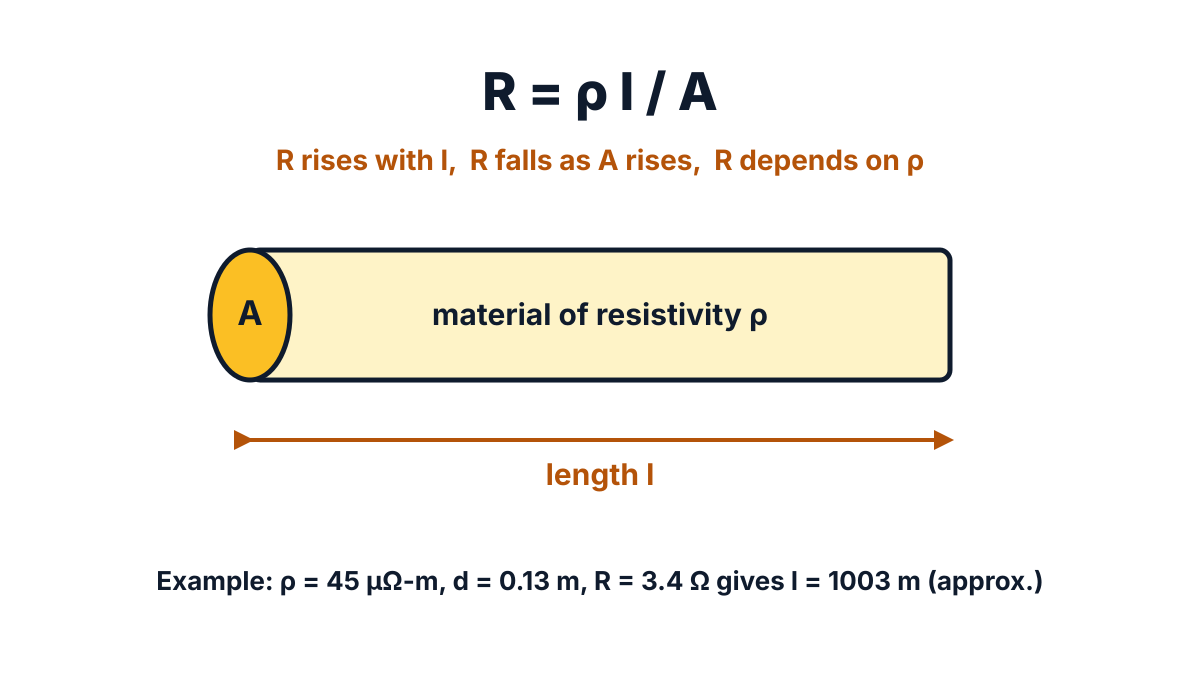
Figure: resistance grows with length and falls as the cross-section area grows.
Derivation. Keep the temperature constant.
- From laws 1 and 2: R ∝ l / A.
- Put in a constant of proportionality ρ: R = ρ l / A.
- ρ (rho) is the specific resistance or resistivity of the material. It depends only on the material and the temperature.
- Rearranging: ρ = R A / l. If l = 1 m and A = 1 m², then ρ = R. So resistivity is the resistance of a unit cube (1 m side) of the material between opposite faces.
- Unit of ρ: ohm × m² / m = ohm-metre (Ω-m).
(b) Length of nichrome wire. Given: ρ = 45 × 10⁻⁶ Ω-m, d = 0.13 m, R = 3.4 Ω.
- Area: A = π d² / 4 = π × 0.0169 / 4 = 0.013273 m².
- From R = ρ l / A: l = R A / ρ.
- l = 3.4 × 0.013273 / (45 × 10⁻⁶) = 1002.87 m.
Answer: l = 1002.87 m, about 1003 m.
Exam tip: a diameter of 0.13 m (13 cm) is far too thick for a heater wire, so the paper most likely meant 0.13 mm. Solve with the printed values as above and write one line saying so; with 0.13 mm the same steps give 1.003 mm. Always convert mm to m before you use the formula.
Q12. (a) Compare series circuits and parallel circuits in any six aspects. (b) Find the current and voltage drops when 10 Ω and 20 Ω are in series across 200 V. (10 marks)
This question has two parts: (a) for 6 marks and (b) for 4 marks.
(a) Series vs parallel circuits.
| Aspect | Series circuit | Parallel circuit |
|---|---|---|
| Connection | Elements connected end to end, one path | Elements connected across the same two points, many paths |
| Current | Same current through every element | Current divides; total I = I₁ + I₂ + … |
| Voltage | Supply voltage divides; V = V₁ + V₂ + … | Same voltage across every element |
| Equivalent resistance | R = R₁ + R₂ + …; more than the largest | 1/R = 1/R₁ + 1/R₂ + …; less than the smallest |
| Effect of one open element | Whole circuit stops working | Other branches keep working |
| Control | All loads switched together | Each load can have its own switch |
| Use | Decorative lamp sets, fuses with the load | House wiring, all domestic appliances |
(b) Series circuit sum. Given: R₁ = 10 Ω, R₂ = 20 Ω, V = 200 V.
- Total resistance: R = R₁ + R₂ = 10 + 20 = 30 Ω.
- Current: I = V / R = 200 / 30 = 6.67 A. In a series circuit this same current flows in each resistor.
- Drop across 10 Ω: V₁ = I R₁ = 6.667 × 10 = 66.67 V.
- Drop across 20 Ω: V₂ = I R₂ = 6.667 × 20 = 133.33 V.
- Check: 66.67 + 133.33 = 200 V.
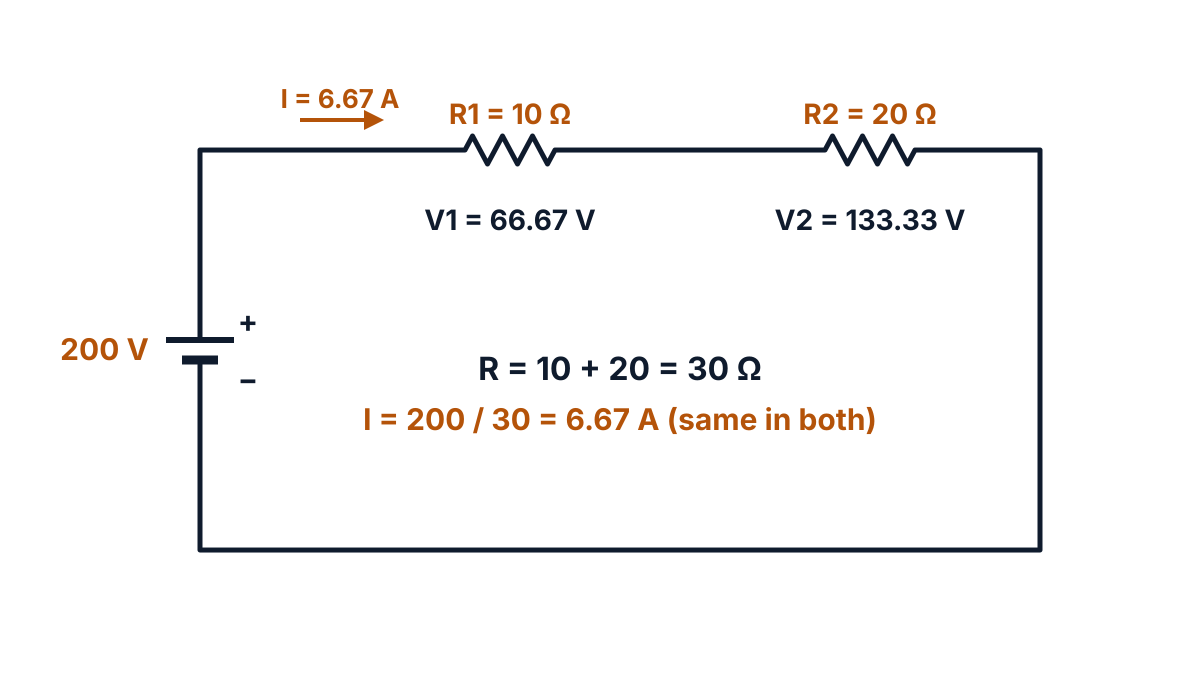
Figure: the larger resistor takes the larger share of the supply voltage.
Answer: I = 6.67 A in each resistor; V₁ = 66.67 V, V₂ = 133.33 V.
Q13. Find the current flowing through all resistors in the following circuit by using Kirchhoff’s voltage law (KVL). (10 marks)
The circuit has a 12.5 V source with 1 Ω in series, then 2 Ω to junction B, a 3 Ω resistor from B down to E, and a right branch of 2.5 Ω and 3 Ω in series. The C-23 syllabus asks for the branch current method, so assign branch currents and write KVL for each loop. The positive terminal of the source is taken at the top, as the figure on the paper shows; a reversed source would only flip all directions.
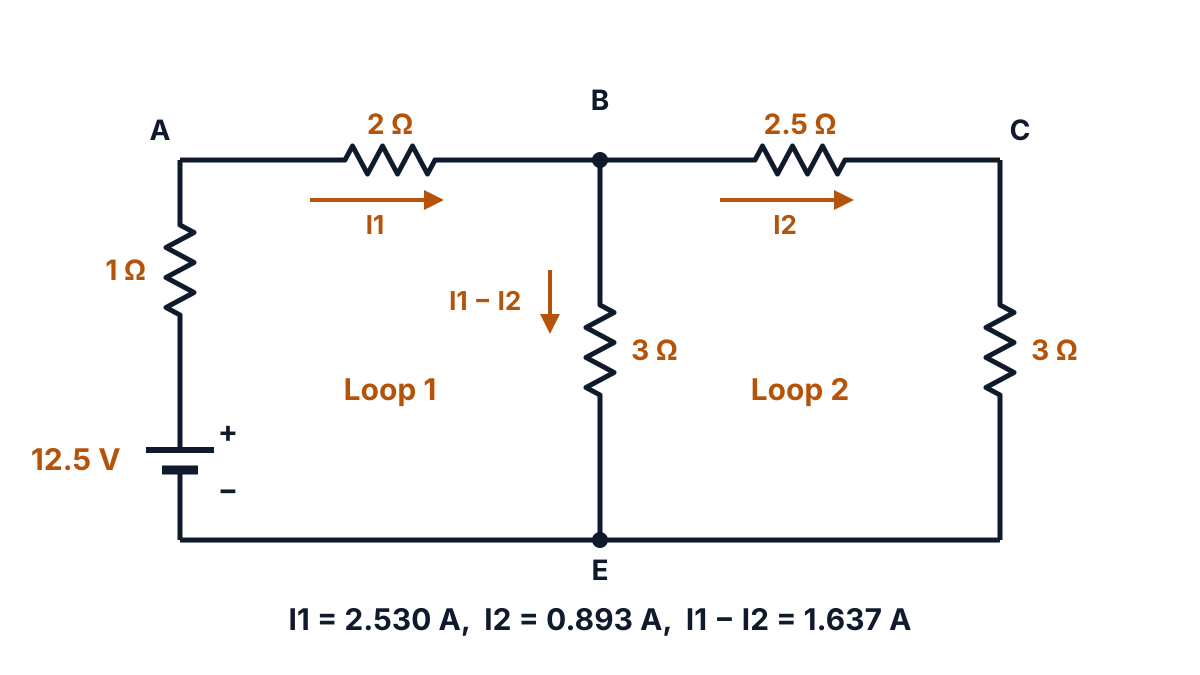
Figure: I₁ flows in the source branch, I₂ in the right branch and (I₁ − I₂) down the middle 3 Ω (KCL at B).
Step 1: branch currents. Let I₁ flow through 1 Ω and 2 Ω, I₂ through 2.5 Ω and the right 3 Ω. By KCL at B, the middle 3 Ω carries (I₁ − I₂).
Step 2: KVL in loop 1 (source, 1 Ω, 2 Ω, middle 3 Ω):
- 12.5 = 1 × I₁ + 2 × I₁ + 3 (I₁ − I₂)
- 12.5 = 6 I₁ − 3 I₂ … (i)
Step 3: KVL in loop 2 (middle 3 Ω, 2.5 Ω, right 3 Ω; no source):
- 0 = 2.5 I₂ + 3 I₂ − 3 (I₁ − I₂)
- 0 = −3 I₁ + 8.5 I₂, so I₁ = 2.833 I₂ … (ii)
Step 4: solve. Put (ii) in (i): 6 × 2.833 I₂ − 3 I₂ = 17 I₂ − 3 I₂ = 14 I₂ = 12.5.
- I₂ = 12.5 / 14 = 0.893 A
- I₁ = 2.833 × 0.893 = 2.530 A
- I₁ − I₂ = 2.530 − 0.893 = 1.637 A
Step 5: check. Drops in loop 1: 2.530 + 5.060 + 4.911 = 12.501 V, which is 12.5 V within rounding. In loop 2: 2.232 + 2.679 = 4.911 V, equal to the drop on the middle 3 Ω. A series-parallel check also gives 12.5 / 4.941 = 2.530 A.
| Resistor | Current |
|---|---|
| 1 Ω and 2 Ω | 2.530 A |
| Middle 3 Ω | 1.637 A |
| 2.5 Ω and right 3 Ω | 0.893 A |
Answer: 2.530 A in 1 Ω and 2 Ω; 1.637 A in the middle 3 Ω; 0.893 A in 2.5 Ω and the right 3 Ω (all rounded to 3 decimals).
Q14. Calculate the monthly bill for a 30 day month for a household with lamps, fans, a mixer grinder and a 1 HP water pump. (10 marks)
Energy in units (kWh) is power in kW times hours. Find the daily energy of each load, add, multiply by 30, then apply the two-slab tariff. For the pump, 1 HP is taken as 746 W, the value NIST’s circular on electrical units uses. That is the pump’s output; the meter records the input, so divide by the efficiency.
Step 1: daily energy of each load.
| Load | Calculation | Energy per day |
|---|---|---|
| (a) 4 lamps, 60 W, 8 h | 4 × 60 × 8 | 1920 Wh |
| (b) 2 fans, 80 W, 5 h | 2 × 80 × 5 | 800 Wh |
| (c) 1 mixer, 500 W, 2 h | 1 × 500 × 2 | 1000 Wh |
| (d) 1 HP pump, 80% efficiency, 2 h | (746 / 0.8) × 2 = 932.5 × 2 | 1865 Wh |
| Total | 1920 + 800 + 1000 + 1865 | 5585 Wh = 5.585 kWh |
Step 2: monthly energy. 5.585 × 30 = 167.55 units.
Step 3: bill.
- First 100 units at Rs 3.25 = 100 × 3.25 = Rs 325.
- Remaining 167.55 − 100 = 67.55 units at Rs 5.00 = Rs 337.75.
- Total = 325 + 337.75 = Rs 662.75.
Answer: energy = 167.55 units per month; bill = Rs 662.75.
Exam tip: students often take the pump at 746 W and forget the efficiency. The input is 932.5 W, not 746 W. If your class uses 1 HP = 735.5 W (metric HP), you get 166.76 units and Rs 658.81; just state the value you used.
Q15. (a) How does an electric cooker produce heat? Explain with diagram. (b) Find the heat needed to raise 1 litre of water from room temperature to 50 °C. (10 marks)
This question has two parts: (a) for 6 marks and (b) for 4 marks.
(a) Electric cooker. An electric cooker produces heat by Joule’s law: current through a high-resistance heating element produces heat H = I²Rt, which flows into the food containers.
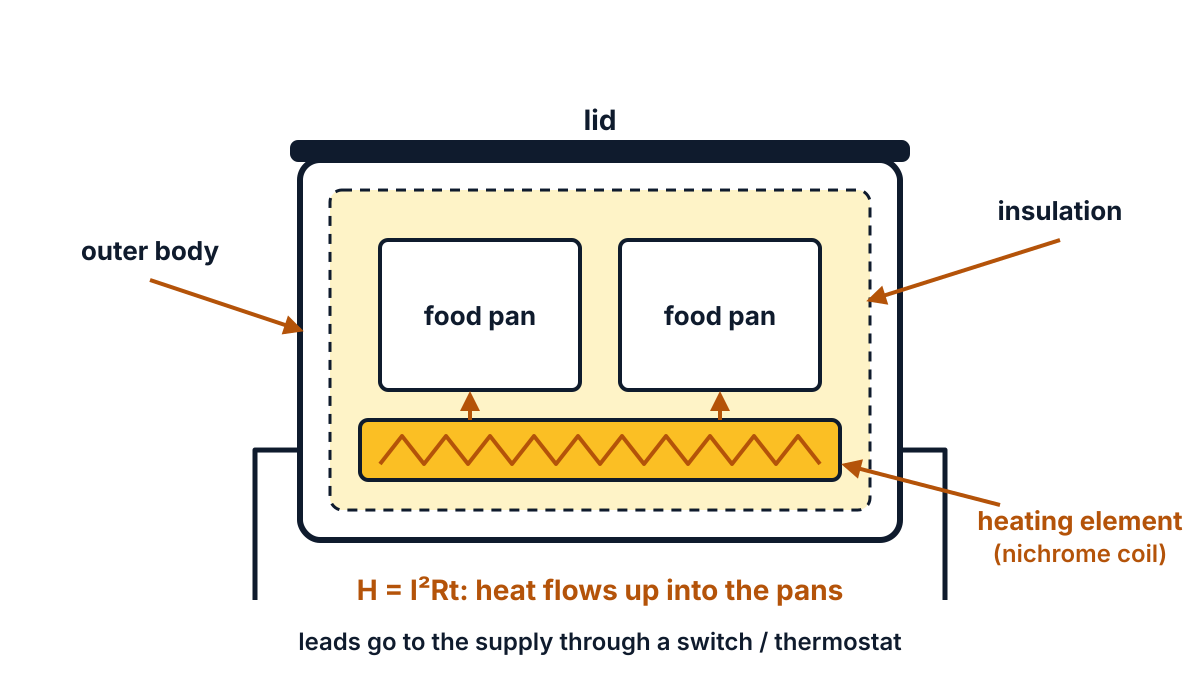
Figure: heat from the element at the bottom rises into the stacked pans; the insulation keeps it inside.
- Heating element: a coil of nichrome wire (high resistivity, high melting point, does not oxidise easily) fitted at the bottom of the cooker. It is insulated electrically from the body, usually with mica.
- Inner vessel and pans: a metal inner chamber holds water and the food pans one above another.
- Thermal insulation: a layer such as glass wool between the inner chamber and the outer body reduces heat loss, so the thermal efficiency is high.
- Outer body and lid: a metal body with a tight lid keeps the steam and heat inside.
- Control: a switch, and in many cookers a thermostat, cuts the supply when the set temperature is reached.
- Working: when the supply is switched on, current flows through the element and heat I²Rt is produced. It passes by conduction to the water and by steam and convection to the pans.
(b) Heat to warm 1 litre of water. Room temperature is not given, so take it as 25 °C and state this.
- Mass of 1 litre of water: m = 1000 g.
- Temperature rise: Δθ = 50 − 25 = 25 °C.
- Heat: H = m × s × Δθ = 1000 × 1 × 25 = 25000 cal (25 kcal).
- In joules: H = 25000 × 4.186 = 104650 J (104.65 kJ).
Answer: H = 25000 cal = 104650 J, for a room temperature of 25 °C.
Q16. Obtain the delta equivalent resistor network from Star equivalent resistor network. (10 marks)
Star-to-delta transformation replaces three star resistors R₁, R₂, R₃ (meeting at a common point N) with three delta resistors R_AB, R_BC, R_CA between the same terminals A, B and C. The two networks are equivalent when the resistance between any pair of terminals is the same in both.
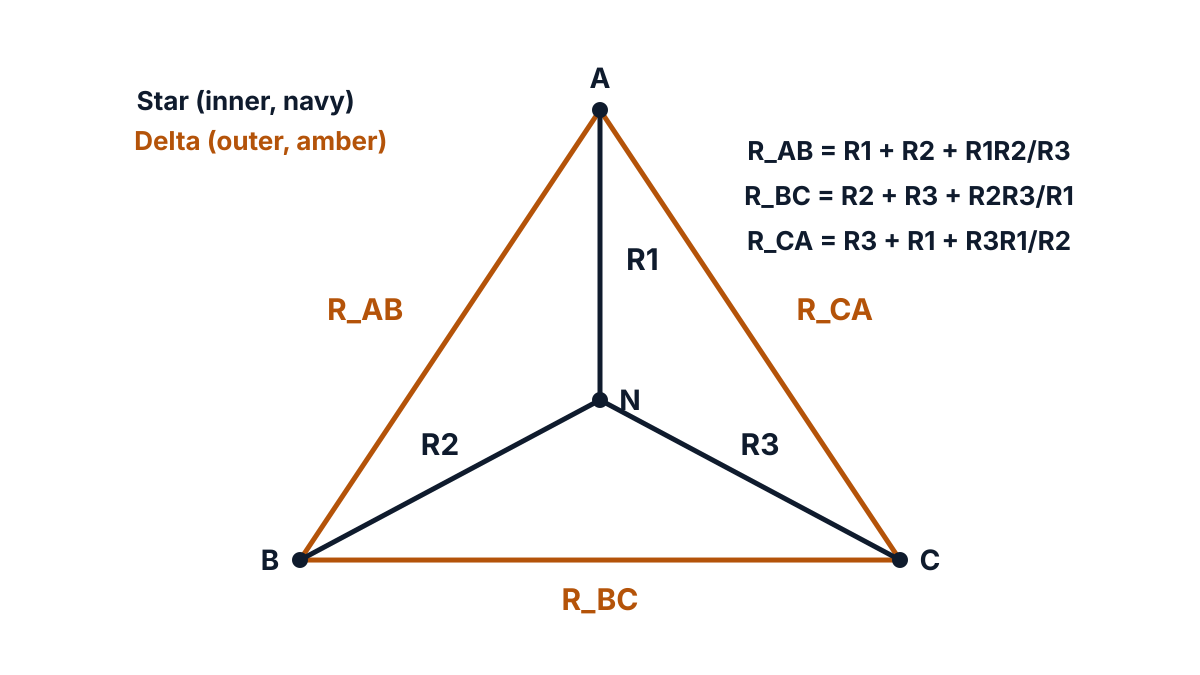
Figure: R₁ is in arm A, R₂ in arm B, R₃ in arm C; each delta resistor sits opposite the star arm that appears in its denominator.
Step 1: equate resistance between each pair (third terminal open). Let ΣR = R_AB + R_BC + R_CA.
- Between A and B: R₁ + R₂ = R_AB (R_BC + R_CA) / ΣR … (1)
- Between B and C: R₂ + R₃ = R_BC (R_CA + R_AB) / ΣR … (2)
- Between C and A: R₃ + R₁ = R_CA (R_AB + R_BC) / ΣR … (3)
Step 2: solve for the star arms. Do (1) − (2) + (3) and divide by 2, and repeat for the others:
- R₁ = R_AB R_CA / ΣR … (4)
- R₂ = R_AB R_BC / ΣR … (5)
- R₃ = R_BC R_CA / ΣR … (6)
Step 3: form the sum of products. Multiply in pairs and add:
- R₁R₂ + R₂R₃ + R₃R₁ = R_AB R_BC R_CA (R_AB + R_BC + R_CA) / ΣR²
- = R_AB R_BC R_CA / ΣR … (7)
Step 4: divide (7) by one star arm.
- Divide (7) by (6): (R₁R₂ + R₂R₃ + R₃R₁) / R₃ = R_AB.
- So R_AB = R₁ + R₂ + R₁R₂ / R₃.
- Divide (7) by (4): R_BC = R₂ + R₃ + R₂R₃ / R₁.
- Divide (7) by (5): R_CA = R₃ + R₁ + R₃R₁ / R₂.
Rule to remember: each delta resistor = sum of the two star resistors at its ends + their product divided by the third star resistor. For a balanced star (R₁ = R₂ = R₃ = R), each delta resistor is 3R.
Key points to write: equal terminal resistances; R_AB = R₁ + R₂ + R₁R₂/R₃ and its two cyclic partners; balanced case R_Δ = 3R_Y.
Q17. State and explain Thevenin’s theorem. (10 marks)
Statement. Any linear, bilateral network with sources and resistors, seen from two terminals A and B, can be replaced by a single voltage source V_th in series with a single resistance R_th. V_th is the open-circuit voltage across A and B. R_th is the resistance between A and B with all sources replaced by their internal resistances (voltage sources shorted, current sources opened). The load current is then
I_L = V_th / (R_th + R_L)
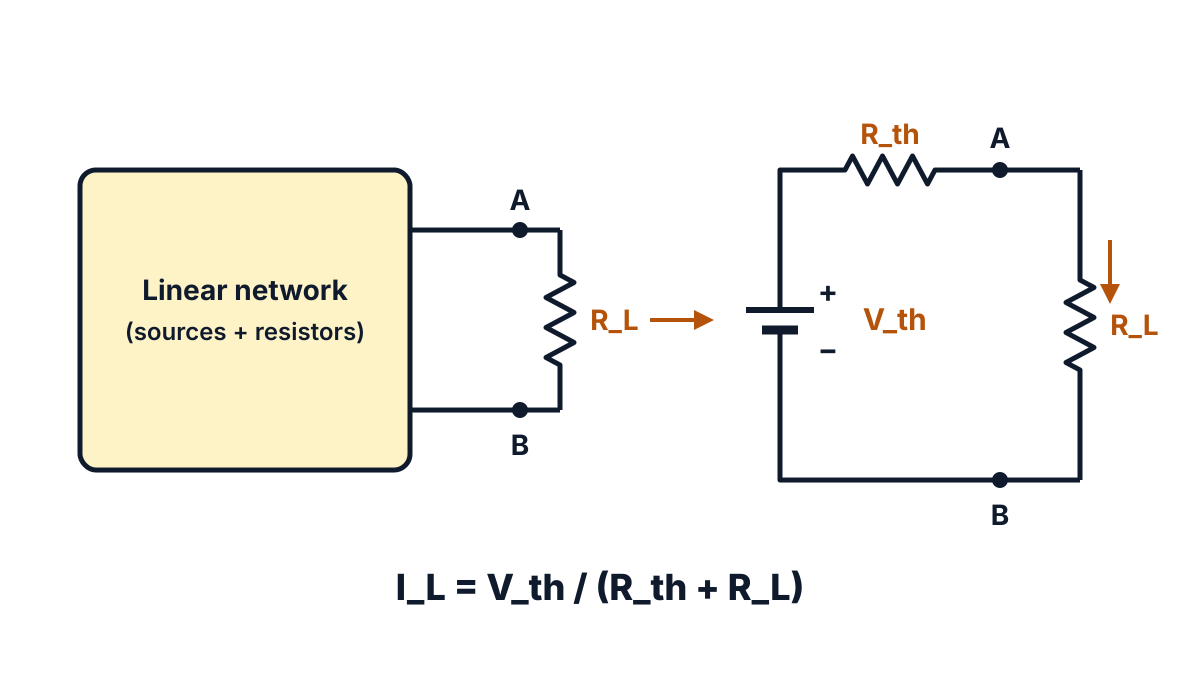
Figure: the whole network on the left becomes one source and one resistor as seen by the load.
Explanation: steps to apply the theorem.
- Remove the load resistance R_L whose current you want, and mark the terminals A and B.
- Find the open-circuit voltage across A and B. This is V_th.
- Replace every voltage source by a short circuit (or its internal resistance) and every current source by an open circuit.
- Find the resistance between A and B looking back into the network. This is R_th.
- Draw the Thevenin equivalent: V_th in series with R_th, and connect R_L back across A and B.
- Find the load current: I_L = V_th / (R_th + R_L).
Short example (the Q18 circuit, load = 3 Ω). Remove the 3 Ω. The loop current from 40 V to 20 V through 5 Ω and 6 Ω is (40 − 20)/11 = 1.818 A, so V_th = 20 + 5 × 1.818 = 29.09 V. With both sources shorted, R_th = 5 ∥ 6 = 2.727 Ω. Then I_L = 29.09 / (2.727 + 3) = 29.09 / 5.727 = 5.079 A, the same answer superposition gives below.
Advantages: one branch can be studied for many load values without solving the whole network again, and it is the basis of the maximum power transfer theorem (R_L = R_th).
Key points to write: statement with V_th (open-circuit) and R_th (sources killed); six steps; I_L = V_th/(R_th + R_L).
Q18. By using super position theorem, find the current flowing through 3 ohm’s resistor in the below circuit. (10 marks)
Superposition theorem: in a linear network with more than one source, the current in any branch is the algebraic sum of the currents produced by each source acting alone, with the other sources replaced by their internal resistances (ideal voltage sources shorted).
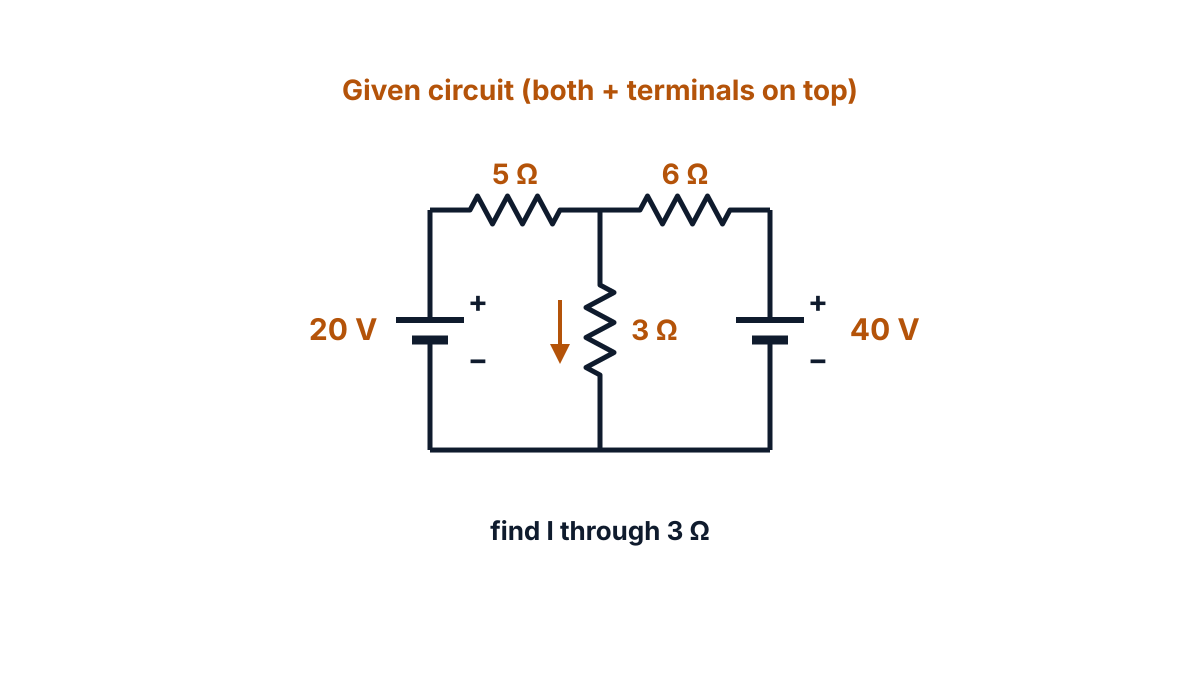
Figure: the given circuit; the positive terminals of both sources are taken at the top, as the paper’s figure shows.
Step 1: 20 V acting alone (40 V shorted).
- 6 Ω is now in parallel with 3 Ω: 6 × 3 / 9 = 2 Ω.
- Total resistance: 5 + 2 = 7 Ω.
- Current from 20 V: 20 / 7 = 2.857 A.
- By current division, current in 3 Ω: I′ = 2.857 × 6 / (6 + 3) = 1.905 A, downward.
Step 2: 40 V acting alone (20 V shorted).
- 5 Ω is now in parallel with 3 Ω: 5 × 3 / 8 = 1.875 Ω.
- Total resistance: 6 + 1.875 = 7.875 Ω.
- Current from 40 V: 40 / 7.875 = 5.079 A.
- Current in 3 Ω: I″ = 5.079 × 5 / (5 + 3) = 3.175 A, downward.
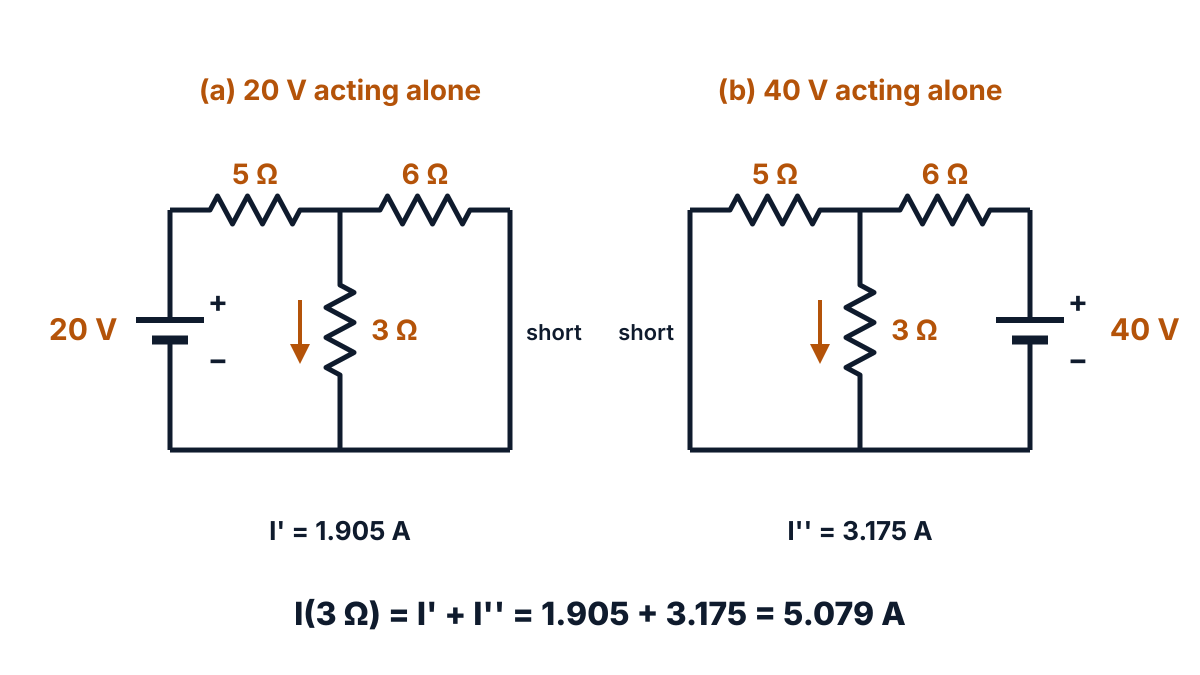
Figure: both sources push current down through the 3 Ω, so the two parts add.
Step 3: add. Both currents flow in the same direction, so I = I′ + I″ = 1.905 + 3.175 = 5.079 A.
Check by node voltage: the top node is at 15.238 V. The 5 Ω carries (20 − 15.238)/5 = 0.952 A and the 6 Ω carries (40 − 15.238)/6 = 4.127 A into the node. 0.952 + 4.127 = 5.079 A = 15.238/3.
Answer: current through the 3 Ω resistor = 5.079 A, flowing downward (from the top junction to the bottom line).
Exam tip: if one source were drawn the other way round, its part would be subtracted, not added. Mark the direction of I′ and I″ on your diagram before you combine them.
FAQ
Which units carry the most marks in the EE-106 March 2025 paper?
Unit 3 (work, power, energy and heating) carries three Part A questions and two Part B questions. Unit 5 (network theorems) carries two of each. Together they hold most of the paper.
Which five Part B questions are easiest to score in this paper?
Q12, Q14, Q13, Q18 and Q11 are mostly numerical with one clear answer each. If you know star-delta well, Q16 is also safe because the derivation is fixed.
What value of horsepower should I use in the electricity bill sum?
Use 1 HP = 746 W, and divide by the efficiency to get the input power the meter records. State the value you used in your answer.
What is wrong with Q11(b) of this paper?
The diameter is printed as 0.13 m, which is 13 cm and far too thick for a heater wire. Solve with the printed values, which give about 1003 m, and mention the likely misprint in one line.
For more sessions of this subject, see the Basic Electrical Technology papers page.
Sources
- AP SBTET C-23 DEEE EE-106 question paper, Mar-Apr 2025
- C-23 Curriculum, Diploma in Electrical and Electronics Engineering, SBTET AP
- Reference books (C-23 syllabus): B.L. Theraja: Electrical Technology Vol. 1, S. Chand
- V.K. Mehta: Introduction to Electrical Engineering
- J.B. Gupta: A Course in Electrical Technology, Katson Books
- G.B. Bharadwajan & A. Subba Rao: Elements of Electrical Engineering
- William H. Hayt: Engineering Circuit Analysis, Tata McGraw-Hill
- Heat and the mechanical equivalent of heat, open college physics text
- NBS Circular 34, value of the horsepower in watts
Writes and reviews the SBTET EEE Papers solutions: AP SBTET diploma question papers answered step by step from the prescribed syllabus.